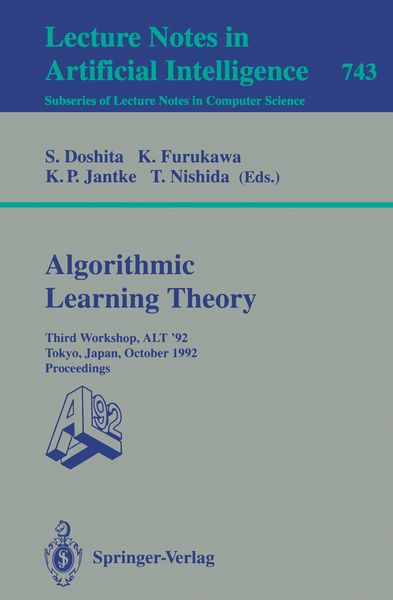
Algorithmic Learning Theory - ALT '92 Third Workshop, ALT '92, Tokyo, Japan, October 20-22, 1992. Proceedings
-
- Englisch ausgewählt
49,99 €
inkl. gesetzl. MwSt.,
Beschreibung
Produktdetails
Einband
Taschenbuch
Erscheinungsdatum
20.10.1993
Abbildungen
XII, 264 p.
Herausgeber
Shuji Doshita + weitereVerlag
Springer BerlinSeitenzahl
264
Maße (L/B/H)
23,5/15,5/1,6 cm
Gewicht
423 g
Auflage
1993
Sprache
Englisch
ISBN
978-3-540-57369-2
Third Workshop onAlgorithmic Learning Theory, held in Tokyo
in October 1992. In addition to 3invited papers, the volume
contains 19 papers accepted for presentation, selected from
29 submitted extended abstracts. The ALT workshops have been
held annually since 1990 and are organized and sponsored by
the Japanese Society for Artificial Intelligence. The main
objective of these workshops is to provide an open forum for
discussions and exchanges of ideasbetween researchers from
various backgrounds in this emerging, interdisciplinary
field of learning theory. The volume is organized into parts
on learning via query, neural networks, inductive inference,
analogical reasoning, and approximate learning.
Noch keine Bewertungen vorhanden
Verfassen Sie die erste Bewertung zu diesem Artikel
Helfen Sie anderen Kundinnen und Kunden durch Ihre Meinung.
Kurze Frage zu unserer Seite
Vielen Dank für dein Feedback
Wir nutzen dein Feedback, um unsere Produktseiten zu verbessern. Bitte habe Verständnis, dass wir dir keine Rückmeldung geben können. Falls du Kontakt mit uns aufnehmen möchtest, kannst du dich aber gerne an unseren Kund*innenservice wenden.
zum Kundenservice