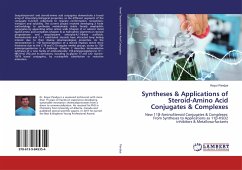
AMINO ACID PRODRUGS OF ACYCLOVIR: OCULAR HERPES INFECTIONS
DESIGN OF AMINO ACID PRODRUGS OF ACYCLOVIR FOR IMPROVED BIOAVAILABILITY AND THERAPEUTIC ACTIVITY: UTILITY IN TREATING OCULAR HERPES INFECTIONS
Versandkostenfrei!
Versandfertig in 6-10 Tagen
59,00 €
inkl. MwSt.

PAYBACK Punkte
0 °P sammeln!

Infection with herpes simplex virus (HSV) is the single most frequent cause of corneal opacities. Current available therapy for HSV keratitis involves the use of trifluorothymidine, idoxuridine and vidarabine. However, one of major problems associated with these drugs is their cytotoxicity. Acyclovir (ACV) with its selective mechanism of action can cause less cytotoxicity but its poor permeability across cellular barrier limits its utility. Thus, the development of a safe, long-acting, effective and stable topical antiviral drops that require less frequent dosing would represent a significant ...
Infection with herpes simplex virus (HSV) is the
single most frequent cause of corneal opacities.
Current available therapy for HSV keratitis involves
the use of trifluorothymidine, idoxuridine and
vidarabine. However, one of major problems
associated with these drugs is their cytotoxicity.
Acyclovir (ACV) with its selective mechanism of
action can cause less cytotoxicity but its poor
permeability across cellular barrier limits its
utility. Thus, the development of a safe, long-
acting, effective and stable topical antiviral drops
that require less frequent dosing would represent a
significant improvement. Recently design of prodrugs
targeted to membrane transporters for improved
efficacy and absorption proved highly successful.
valacyclovir (VACV) is such a prodrug that increased
the oral bioavailability of ACV by 3-5 fold in
humans. Recently the presence of these transport
systems on the corneal epithelium has been
established in our laboratory. A series of novel
water soluble amino acid ester prodrugs of ACV were
thus synthesized. In conclusion more permeable, less
cytotoxic Ser-acyclovir (SACV) exhibited excellent
antiviral activity against HSV viruses.
single most frequent cause of corneal opacities.
Current available therapy for HSV keratitis involves
the use of trifluorothymidine, idoxuridine and
vidarabine. However, one of major problems
associated with these drugs is their cytotoxicity.
Acyclovir (ACV) with its selective mechanism of
action can cause less cytotoxicity but its poor
permeability across cellular barrier limits its
utility. Thus, the development of a safe, long-
acting, effective and stable topical antiviral drops
that require less frequent dosing would represent a
significant improvement. Recently design of prodrugs
targeted to membrane transporters for improved
efficacy and absorption proved highly successful.
valacyclovir (VACV) is such a prodrug that increased
the oral bioavailability of ACV by 3-5 fold in
humans. Recently the presence of these transport
systems on the corneal epithelium has been
established in our laboratory. A series of novel
water soluble amino acid ester prodrugs of ACV were
thus synthesized. In conclusion more permeable, less
cytotoxic Ser-acyclovir (SACV) exhibited excellent
antiviral activity against HSV viruses.
Andere Kunden interessierten sich für