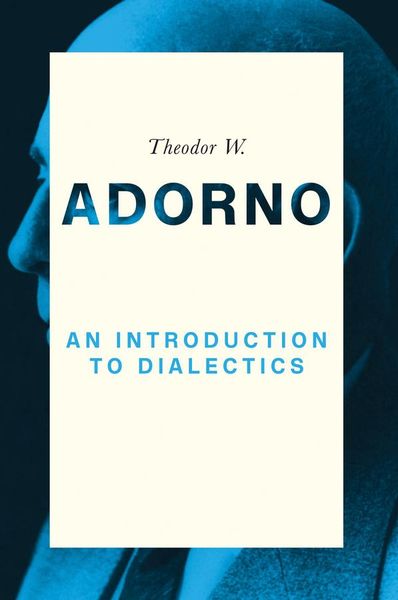
Produktbild: An Introduction to Dialectics (1958)

An Introduction to Dialectics (1958)

81,99 €

inkl. gesetzl. MwSt., Versandkostenfrei

Lieferung nach Hause

Beschreibung

Produktdetails

Einband

Gebundene Ausgabe

Erscheinungsdatum

27.03.2017

Herausgeber

Christoph Ziermann

Verlag

John Wiley & Sons Inc

Seitenzahl

336

Maße (L/B/H)

23,1/16,1/3,2 cm

Gewicht

646 g

Auflage

1. Auflage

Sprache

Englisch

ISBN

978-0-7456-9311-8

Beschreibung

Rezension

"Despite Adorno's abiding suspicion of easy communicability, he was fully capable of explaining complex ideas lucidly and accessibly, never more so than in the lecture hall. There can be few concepts that demand as much careful exposition as 'dialectics,' whose multiple uses and frequent abuses have frustrated countless attempts to render it comprehensible. Still fewer exponents of dialectical thought have been as skilled in unpacking its meaning, while at the same time performatively demonstrating its virtues, as Adorno."
Martin Jay, University of California, Berkeley
 
"The twenty lectures that Adorno held in 1958 constitute the first comprehensive articulation of his thinking. The challenge to which he responds is that of wresting conceptual thinking from its narcissistic tendencies, as outlined in Dialectics of Enlightenment. 'Suffering and Happiness,' he insists, must be recognized as 'the immanent substance of dialectics'. Adorno's effort to turn thinking inside-out by revealing the affective origin of its transformative potential, remains his most enduring legacy."
Samuel Weber, Northwestern University

Produktdetails

Einband

Gebundene Ausgabe

Erscheinungsdatum

27.03.2017

Herausgeber

Christoph Ziermann

Verlag

John Wiley & Sons Inc

Seitenzahl

336

Maße (L/B/H)

23,1/16,1/3,2 cm

Gewicht

646 g

Auflage

1. Auflage

Sprache

Englisch

ISBN

978-0-7456-9311-8

Herstelleradresse

Libri GmbH
Europaallee 1
36244 Bad Hersfeld
DE

Email: GPSR Kontakt

Noch keine Bewertungen vorhanden

Verfassen Sie die erste Bewertung zu diesem Artikel

Helfen Sie anderen Kundinnen und Kunden durch Ihre Meinung.

Kundinnen und Kunden meinen

Bewertungen (0)

Die Leseprobe wird geladen.
  • Produktbild: An Introduction to Dialectics (1958)
  • Editor's Foreword
    LECTURE ONE
    Prejudices against the dialectic
    the double character of the dialectic
    the dialectic as method of articulating the Ideas (Plato)
    the order of concepts expresses the order of things
    the vital nerve of the dialectic
    the dialectic as necessary 'exaggeration'
    the positivist element of the dialectic
    LECTURE TWO
    'The movement of the concept' (Hegel)
    the dialectic hypostasizes the identity of thought and being
    Hegel's dialectic as the union of identity and non-identity
    non-identity in the process, identity in the result
    introduction to the dialectic as a model of dialectic
    the movement of the concept is not sophistical
    the movement of the concept as the path of philosophical science
    the object of knowledge is internally dynamic
    the movement of the object is not arbitrary
    the metaphysical concept of truth
    the inevitable reification of truth
    historical movement is not the movement of being but is concrete
    the dialectic is not a philosophy of foundations
    the temporal core of dialectic
    LECTURE THREE
    Critique of prima philosophia
    matter no first principle either
    Hegel's dialectic also a preservation of first philosophy
    all determination implies mediation
    the movement of the concept is no external contribution of thought
    a sophistical displacement of meaning in Gehlen
    the whole is the true solely as the result of all mediations ? the idea of an open dialectic
    the whole is neither a pantheistic totality of nature nor a seamless unity
    'the truth is essentially result'
    individual phenomena only intelligible in terms of the whole
    recourse to the whole is mediated through the self-movement of the individual
    the concept of the whole as already given
    LECTURE FOUR
    The traditional concept of system: derivation of the whole from one fundamental principle
    the dialectical concept of system
    determinate negation
    contradiction in Kant
    contradiction in Hegel
    antithesis arises from thesis
    the measure of the absolute lies in objectivity
    dialectical criticism is necessarily immanent
    refutation of a thought as development of the thought
    the emergent absolute is essentially temporal
    the interaction of theory and practice
    the truth as result is concrete
    LECTURE FIVE
    The charge of universal rationalization
    dialectical thought is not rationalistic thought
    the dispute over rationalism
    conceptual thought is indispensable
    the truth moment of irrationalism
    the irrational as a moment of ratio
    suffering and happiness are immanent to thought
    being in itself, being for itself, being in and for itself
    relationship of thesis, antithesis, synthesis
    dialectical method concerns the contradictory life of the object
    the dialectic not immune to ideological abuse
    LECTURE SIX
    Dialectical method not a formal conceptual schema
    the objectivation of truth
    every true thought becomes untrue once it is isolated
    the triadic schema irrelevant in Hegel
    the charge of universalizing contradiction
    contradiction is not a first principle
    Hegel's critique of Kant's transcendental dialectic
    LECTURE SEVEN
    Hegel's dialectical principle of development is a principle of real being
    dialectic in Kant is only the negative side of the critique of reason
    the positive moment of the critique of reason
    reflection as the principle of the speculative self-knowledge of reason
    knowledge of knowledge also the principle of substantive knowledge
    dialectic and formal logic - the 'example' in Hegel
    logical form of the judgement and the 'emphatic concept'
    dialectical contradiction expresses the disparity of thought and world
    LECTURE EIGHT
    Dialectic names the negative state of the world by its proper name
    contradiction not only in thought, but is objective
    contradiction as principle of diremption is also the principle of unity
    dialectic as union