Gutscheinbedingungen

**Gültig vom 15.06.2026 bis 17.06.2026 | Gültig für nicht preisgebundene fremdsprachige Bücher | Einzelne Artikel können ausgeschlossen sein | Maximaler rabattfähiger Warenkorbwert 500 € | Nicht kombinierbar mit weiteren Aktionen | Nur einmal pro Person einlösbar | Nur solange der Vorrat reicht

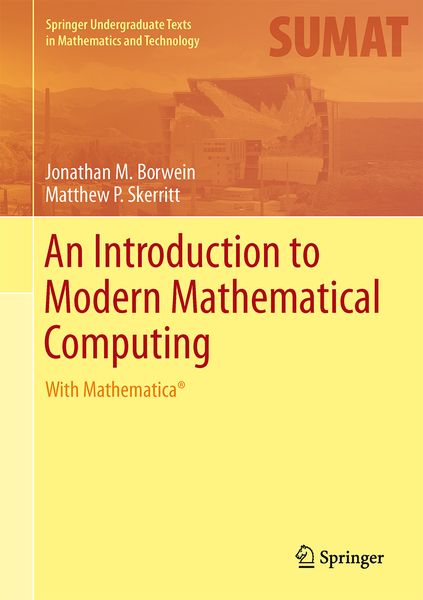
Produktbild: An Introduction to Modern Mathematical Computing

An Introduction to Modern Mathematical Computing With Mathematica®

53,99 €

inkl. gesetzl. MwSt., Versandkostenfrei

Lieferung nach Hause

Beschreibung

Produktdetails

Einband

Gebundene Ausgabe

Erscheinungsdatum

04.08.2012

Verlag

Springer Us

Seitenzahl

224

Maße (L/B/H)

26,1/18,5/2 cm

Gewicht

611 g

Auflage

2012 edition

Sprache

Englisch

ISBN

978-1-4614-4252-3

Beschreibung

Rezension

From the reviews:

“There are two general approaches to computation: using computation as a numerical tool to approximate answers or using a computer algebra system to provide exact mathematical answers by symbolic manipulation. This book explores the second of these approaches, using the computer algebra system Mathematica. … Though this work does teach students how to use Mathematica, it does so with the goal of providing new insights into basic mathematics, which can then be applied to more advanced mathematics. … Summing Up: Recommended. Lower- and upper-division undergraduates.” (D. Z. Spicer, Choice, Vol. 50 (7), March, 2013)

“Three main chapters form the core of the book. In the first chapter, the authors talk about using a computer algebra system like Mathematica for problems in number theory … . Chapters 2 and 3 are devoted to calculus and linear algebra, respectively. … The mathematical content of the chapters is … elementary and written in a style easily understandable by nonspecialists. … a very good introduction for beginners to this interesting and important topic.” (Kai Diethelm, ACM Computing Reviews, March, 2013)

Zitat

From the reviews:
"There are two general approaches to computation: using computation as a numerical tool to approximate answers or using a computer algebra system to provide exact mathematical answers by symbolic manipulation. This book explores the second of these approaches, using the computer algebra system Mathematica. ... Though this work does teach students how to use Mathematica, it does so with the goal of providing new insights into basic mathematics, which can then be applied to more advanced mathematics. ... Summing Up: Recommended. Lower- and upper-division undergraduates." (D. Z. Spicer, Choice, Vol. 50 (7), March, 2013)
"Three main chapters form the core of the book. In the first chapter, the authors talk about using a computer algebra system like Mathematica for problems in number theory ... . Chapters 2 and 3 are devoted to calculus and linear algebra, respectively. ... The mathematical content of the chapters is ... elementary and written in a style easily understandable by nonspecialists. ... a very good introduction for beginners to this interesting and important topic." (Kai Diethelm, ACM Computing Reviews, March, 2013)

Produktdetails

Einband

Gebundene Ausgabe

Erscheinungsdatum

04.08.2012

Verlag

Springer Us

Seitenzahl

224

Maße (L/B/H)

26,1/18,5/2 cm

Gewicht

611 g

Auflage

2012 edition

Sprache

Englisch

ISBN

978-1-4614-4252-3

Herstelleradresse

Libri GmbH
Europaallee 1
36244 Bad Hersfeld
DE

Email: gpsr@libri.de

Kundinnen und Kunden meinen

0 Bewertungen

Informationen zu Bewertungen

Zur Abgabe einer Bewertung ist eine Anmeldung im Konto notwendig. Die Authentizität der Bewertungen wird von uns nicht überprüft. Wir behalten uns vor, Bewertungstexte, die unseren Richtlinien widersprechen, entsprechend zu kürzen oder zu löschen.

Die Bewertungen sind nach Format, Anzahl Sterne und Datum sortiert.

Verfassen Sie die erste Bewertung zu diesem Artikel

Helfen Sie anderen Kund*innen durch Ihre Meinung

Kundinnen und Kunden meinen

0 Bewertungen filtern

  • Produktbild: An Introduction to Modern Mathematical Computing
  • Preface.- Conventions and Notation.- 1. Number Theory.- 2. Calculus.- 3. Linear Algebra.- 4. Visualisation and Geometry: a Postscript.- Sample Quizzes.- Index.- References.-