KI-Beratung Beta

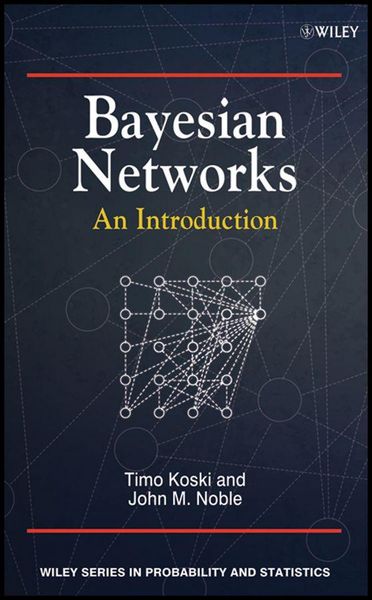
Produktbild: Bayesian Networks

Bayesian Networks An Introduction

137,99 €

inkl. gesetzl. MwSt., Versandkostenfrei


Beschreibung

Produktdetails

Einband

Gebundene Ausgabe

Erscheinungsdatum

01.11.2009

Verlag

John Wiley & Sons Inc

Seitenzahl

368

Maße (L/B/H)

25,2/17,7/2,9 cm

Gewicht

812 g

Auflage

1. Auflage

Sprache

Englisch

ISBN

978-0-470-74304-1

Beschreibung

Rezension

"It assumes only a basic knowledge of probability, statistics andmathematics and is well suited for classroom teaching . . . Eachchapter of the book is concluded with short notes on the literatureand a set of helpful exercises." (Mathematical Reviews, 2011)

"Extensively tested in classroom teaching ... .The authorsclearly define all concepts and provide numerous examples andexercises." ( Book News , December 2009)

Produktdetails

Einband

Gebundene Ausgabe

Erscheinungsdatum

01.11.2009

Verlag

John Wiley & Sons Inc

Seitenzahl

368

Maße (L/B/H)

25,2/17,7/2,9 cm

Gewicht

812 g

Auflage

1. Auflage

Sprache

Englisch

ISBN

978-0-470-74304-1

Herstelleradresse

Libri GmbH
Europaallee 1
36244 Bad Hersfeld
DE

Email: gpsr@libri.de

Noch keine Bewertungen vorhanden

Verfassen Sie die erste Bewertung zu diesem Artikel

Helfen Sie anderen Kundinnen und Kunden durch Ihre Meinung.

Kundinnen und Kunden meinen

Bewertungen (0)

Die Leseprobe wird geladen.
  • Produktbild: Bayesian Networks
  • Preface.
     
    1 Graphical models and probabilistic reasoning.
     
    1.1 Introduction.
     
    1.2 Axioms of probability and basic notations.
     
    1.3 The Bayes update of probability.
     
    1.4 Inductive learning.
     
    1.5 Interpretations of probability and Bayesian networks.
     
    1.6 Learning as inference about parameters.
     
    1.7 Bayesian statistical inference.
     
    1.8 Tossing a thumb-tack.
     
    1.9 Multinomial sampling and the Dirichlet integral.
     
    Notes.
     
    Exercises: Probabilistic theories of causality, Bayes' rule, multinomial sampling and the Dirichlet density.
     
    2 Conditional independence, graphs and d-separation.
     
    2.1 Joint probabilities.
     
    2.2 Conditional independence.
     
    2.3 Directed acyclic graphs and d-separation.
     
    2.4 The Bayes ball.
     
    2.5 Potentials.
     
    2.6 Bayesian networks.
     
    2.7 Object oriented Bayesian networks.
     
    2.8 d-Separation and conditional independence.
     
    2.9 Markov models and Bayesian networks.
     
    2.10 I-maps and Markov equivalence.
     
    Notes.
     
    Exercises: Conditional independence and d-separation.
     
    3 Evidence, sufficiency and Monte Carlo methods.
     
    3.1 Hard evidence.
     
    3.2 Soft evidence and virtual evidence.
     
    3.3 Queries in probabilistic inference.
     
    3.4 Bucket elimination.
     
    3.5 Bayesian sufficient statistics and prediction sufficiency.
     
    3.6 Time variables.
     
    3.7 A brief introduction to Markov chain Monte Carlo methods.
     
    3.8 The one-dimensional discrete Metropolis algorithm.
     
    Notes.
     
    Exercises: Evidence, sufficiency and Monte Carlo methods.
     
    4 Decomposable graphs and chain graphs.
     
    4.1 Definitions and notations.
     
    4.2 Decomposable graphs and triangulation of graphs.
     
    4.3 Junction trees.
     
    4.4 Markov equivalence.
     
    4.5 Markov equivalence, the essential graph and chain graphs.
     
    Notes.
     
    Exercises: Decomposable graphs and chain graphs.
     
    5 Learning the conditional probability potentials.
     
    5.1 Initial illustration: maximum likelihood estimate for a fork connection.
     
    5.2 The maximum likelihood estimator for multinomial sampling.
     
    5.3 MLE for the parameters in a DAG: the general setting.
     
    5.4 Updating, missing data, fractional updating.
     
    Notes.
     
    Exercises: Learning the conditional probability potentials.
     
    6 Learning the graph structure.
     
    6.1 Assigning a probability distribution to the graph structure.
     
    6.2 Markov equivalence and consistency.
     
    6.3 Reducing the size of the search.
     
    6.4 Monte Carlo methods for locating the graph structure.
     
    6.5 Women in mathematics.
     
    Notes.
     
    Exercises: Learning the graph structure.
     
    7 Parameters and sensitivity.
     
    7.1 Changing parameters in a network.
     
    7.2 Measures of divergence between probability distributions.
     
    7.3 The Chan-Darwiche distance measure.
     
    7.4 Parameter changes to satisfy query constraints.
     
    7.5 The sensitivity of queries to parameter changes.
     
    Notes.
     
    Exercises: Parameters and sensitivity.
     
    8 Graphical models and exponential families.
     
    8.1 Introduction to exponential families.
     
    8.2 Standard examples of exponential families.
     
    8.3 Graphical models and exponential families.
     
    8.4 Noisy 'or' as an exponential family.
     
    8.5 Properties of the log partition function.
     
    8.6 Fenchel Legendre conjugate.
     
    8.7 Kullback-Leibler divergence.
     
    8.8 Mean fi