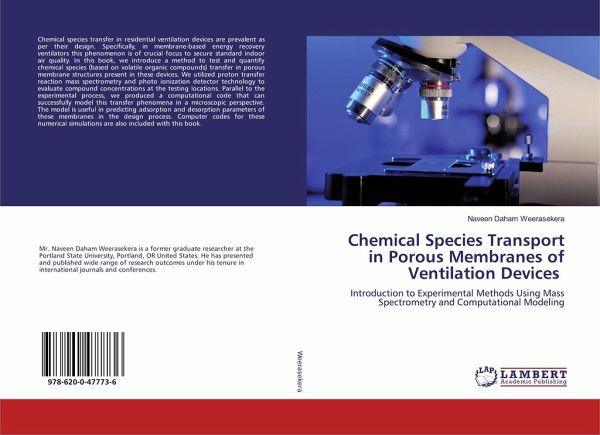
Chemical Species Transport in Porous Membranes of Ventilation Devices
Introduction to Experimental Methods Using Mass Spectrometry and Computational Modeling
Versandkostenfrei!
Versandfertig in 1-2 Wochen
36,99 €
inkl. MwSt.

PAYBACK Punkte
18 °P sammeln!

Chemical species transfer in residential ventilation devices are prevalent as per their design. Specifically, in membrane-based energy recovery ventilators this phenomenon is of crucial focus to secure standard indoor air quality. In this book, we introduce a method to test and quantify chemical species (based on volatile organic compounds) transfer in porous membrane structures present in these devices. We utilized proton transfer reaction mass spectrometry and photo ionization detector technology to evaluate compound concentrations at the testing locations. Parallel to the experimental proce...
Chemical species transfer in residential ventilation devices are prevalent as per their design. Specifically, in membrane-based energy recovery ventilators this phenomenon is of crucial focus to secure standard indoor air quality. In this book, we introduce a method to test and quantify chemical species (based on volatile organic compounds) transfer in porous membrane structures present in these devices. We utilized proton transfer reaction mass spectrometry and photo ionization detector technology to evaluate compound concentrations at the testing locations. Parallel to the experimental process, we produced a computational code that can successfully model this transfer phenomena in a microscopic perspective. The model is useful in predicting adsorption and desorption parameters of these membranes in the design process. Computer codes for these numerical simulations are also included with this book.
Andere Kunden interessierten sich für