
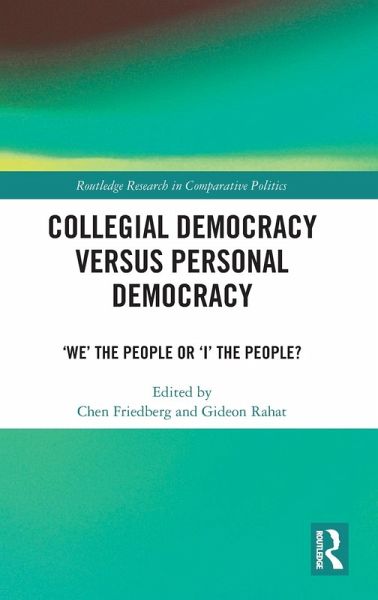
Collegial Democracy versus Personal Democracy
'We' the People or 'I' the People?
Herausgegeben: Friedberg, Chen; Rahat, Gideon
Versandkostenfrei!
Versandfertig in 6-10 Tagen
154,99 €
inkl. MwSt.
Weitere Ausgaben:

PAYBACK Punkte
77 °P sammeln!

This book examines two patterns of democracy - collegial and personal - through a comprehensive comparison of political institutions.It develops a conceptual, theoretical, and methodological basis for differentiating collegial and personal democracies. Central institutions in democracy are classified according to their levels of personalism and collegialism, including political parties, candidate selection methods and electoral systems, legislature, and cabinets and governments. The book presents preliminary findings concerning the causes for this variance between the two democratic regime typ...
This book examines two patterns of democracy - collegial and personal - through a comprehensive comparison of political institutions.
It develops a conceptual, theoretical, and methodological basis for differentiating collegial and personal democracies. Central institutions in democracy are classified according to their levels of personalism and collegialism, including political parties, candidate selection methods and electoral systems, legislature, and cabinets and governments. The book presents preliminary findings concerning the causes for this variance between the two democratic regime types.
The book will be of key interest to students and scholars of democratic institutions, personalism and personalization, political parties and, more broadly, democracy.
It develops a conceptual, theoretical, and methodological basis for differentiating collegial and personal democracies. Central institutions in democracy are classified according to their levels of personalism and collegialism, including political parties, candidate selection methods and electoral systems, legislature, and cabinets and governments. The book presents preliminary findings concerning the causes for this variance between the two democratic regime types.
The book will be of key interest to students and scholars of democratic institutions, personalism and personalization, political parties and, more broadly, democracy.
Andere Kunden interessierten sich für