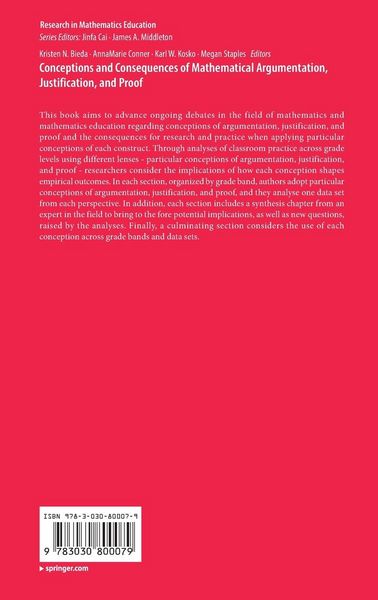
• Produktbild: Conceptions and Consequences of Mathematical Argumentation, Justification, and Proof
  • Produktbild: Conceptions and Consequences of Mathematical Argumentation, Justification, and Proof
- 10%

Conceptions and Consequences of Mathematical Argumentation, Justification, and Proof

10% sparen

162,99 € UVP 181,89 €

inkl. gesetzl. MwSt., Versandkostenfrei


Beschreibung

Produktdetails

Einband

Gebundene Ausgabe

Erscheinungsdatum

04.03.2022

Abbildungen

XV, 333 p. 46 illus., 12 illus. in color.

Herausgeber

Kristen N. Bieda + weitere

Verlag

Springer

Seitenzahl

333

Maße (L/B/H)

24,1/16/2,5 cm

Gewicht

694 g

Auflage

22001 Auflage 1st edition 2022

Sprache

Englisch

ISBN

978-3-030-80007-9

Beschreibung

Portrait


Kristen Bieda is an associate professor of Teacher Education and Mathematics Education at Michigan State University. She also holds an appointment as the Associate Director of Mathematics for the CREATE for STEM Institute. Prior to her appointment at Michigan State, she taught mathematics at the middle school, high school and community college levels. Her research interests include understanding how to incorporate mathematical justification into school mathematics, particularly at the middle school level. She is also interested in the design of clinical experiences that support prospective teachers in learning to teach ambitiously. She is currently the subject area leader for secondary mathematics for Michigan State’s secondary mathematics teacher preparation program.

AnnaMarie Conner is a professor of Mathematics Education in the Mary Frances Early College of Education at the University of Georgia. She investigates teachers’ beliefs and identity construction during teacher education and how teachers learn to support collective argumentation in mathematics classes. These two lines of research come together in findings describing how teachers’ beliefs impact their classroom practice with respect to collective argumentation. Dr. Conner’s work investigates the complex connections between teacher education, teacher characteristics, and teacher practice. She is currently collaborating with secondary mathematics teachers in supporting mathematical arguments as well as investigating how elementary teachers navigate infusing argumentation into integrative STEM instruction.

Karl W. Kosko is an associate professor of Mathematics Education at Kent State University. His work focuses on how mathematical meaning is conveyed, and has addressed classroom argumentation and discourse, multiplicative reasoning, and use of representations of practice in teacher education.

Megan Staples is an associate professor of Mathematics Education in the NeagSchool of Education, University of Connecticut. Her teaching focuses on the preparation of secondary math teachers. Her research focuses on how teachers organize classroom environments that support powerful practices such as collaboration, justification and argumentation. She has served as PI and Co-PI on multiple grants focused on justification and argumentation including the NSF-funded JAGUAR project, and a state-level Math-Science Partnership grant, Bridging Math Practices.

Produktdetails

Einband

Gebundene Ausgabe

Erscheinungsdatum

04.03.2022

Abbildungen

XV, 333 p. 46 illus., 12 illus. in color.

Herausgeber

Verlag

Springer

Seitenzahl

333

Maße (L/B/H)

24,1/16/2,5 cm

Gewicht

694 g

Auflage

22001 Auflage 1st edition 2022

Sprache

Englisch

ISBN

978-3-030-80007-9

Herstelleradresse

Springer-Verlag KG
Sachsenplatz 4-6
1201 Wien
AT

Email: ProductSafety@springernature.com

Noch keine Bewertungen vorhanden

Verfassen Sie die erste Bewertung zu diesem Artikel

Helfen Sie anderen Kundinnen und Kunden durch Ihre Meinung.

Kundinnen und Kunden meinen

Bewertungen (0)

Weitere Artikel findest du in

  • Produktbild: Conceptions and Consequences of Mathematical Argumentation, Justification, and Proof
  • Produktbild: Conceptions and Consequences of Mathematical Argumentation, Justification, and Proof

  • Introduction: Conceptualizing Argumentation, Justification, and Proof in Mathematics Education.- 
    Part 1: Argumentation, Justification and Proof in an Elementary Classroom.- 
    Overview of the Elementary Level Data.- Argumentation in the Elementary Grades: The Role of Participants, Tasks, and Tools.- Justification in the Elementary Grades: Justification to Develop and Provide Access to Mathematical Reasoning.- Proof in the Elementary Grades: A Multimodal Approach to Generalization and Proof.- On the Meanings of Argumentation, Justification, and Proof: General Insights from Analyses of Elementary Classroom Episodes.- 
    Part 2: Argumentation, Justification and Proof in a Middle Grades Classroom.- 
    Overview of Middle Level Data.- Argumentation in the Middle Grades: Exploring a Teacher’s Support of Collective Argumentation.- Justification in the Middle Grades: A Process of Verification and Sense-Making.- Proof in the Middle Grades: Can we Label Middle Grades Arguments as Proof with a Capital P?.- Argumentation, Justification, and Proof in Middle School: A Rose by Any Other Name.- 
    Part 3: Argumentation, Justification and Proof in High School Mathematics.- 
    Overview of High School Level Data.- Argumentation in the Context of High School Mathematics: Examining Dialogic Aspects of Argumentation.- Justification in the Context of High School Mathematics: Co-Constructing Content and Process.- Proof in the Context of High School Mathematics: A First Approach through Discussion, with Occasions and Missed Opportunities.- Reasoning is in the Eye of the Lens-Holder: Observations Made through the Lenses of Justification, Argumentation, and Proof at the High School Level.- 
    Part 4: Argumentation, Justification and Proof at the Tertiary Level.- 
    Overview of Tertiary Level Data.- Argumentation in the Context of Tertiary Mathematics: A Case Study of Classroom Argumentation and the Role of Instructor Moves.- Justification in the Context of Tertiary Mathematics: Undergraduate Students Exploring the Properties and Relations of the Dihedral Group.- Proof in the Context of Tertiary Mathematics: Undergraduate Inquiry-Based Learning in Abstract Algebra as a Precursor to Mathematical Proof.- Mathematics Educators as Polymaths, Brokers, and Learners: Commentary on the Tertiary Chapters on Argumentation, Justification, and Proof.- 
    Part 5: Lenses on Researching Argumentation, Justification and Proof Across the Grade Levels.- 
    Participation in Argumentation: Teacher and Student Roles across the Grades.- Justification Across the Grade Bands.- Lens, Blinders, or Kaleidoscope? Using a Definition of Proof to Make Sense of Classroom Activity.- Conclusion: Considering the Consequences of Our Conceptions of Argumentation, Justification, and Proof.