Beschreibung
Produktdetails
Einband
Taschenbuch
Erscheinungsdatum
07.11.2018
Verlag
Cognella Academic PublishingSeitenzahl
460
Maße (L/B/H)
28/21,6/2,5 cm
Gewicht
1148 g
Sprache
Englisch
ISBN
978-1-5165-0847-1
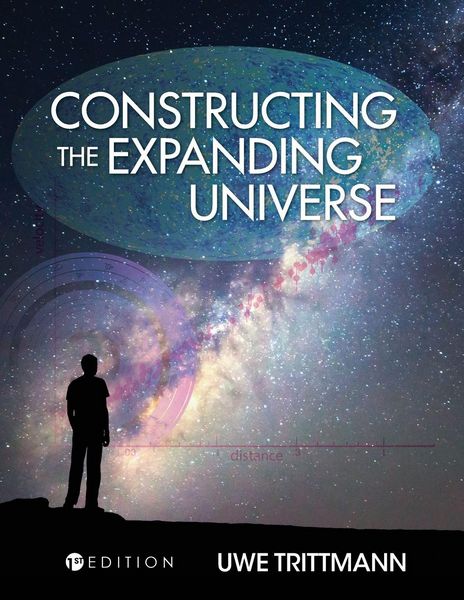
Constructing the Expanding Universe provides students with a comprehensive exploration of the history of the evolving cosmos. In the text, the universe is seen as both physically and intellectually expanding as its physical characteristics evolve and our knowledge of the cosmos grows. It introduces students to fundamental scientific concepts that nurture the scientist in each and every reader. Chapter 1 helps students understand how astronomical objects are observed and identified. The focus is on the basic patterns in nature, such as daily and seasonal motion of celestial bodies visible to the naked eye. Chapter 2 explores the history of astronomy up to the scientific revolution, including laws and theories developed by the ancient Greeks, Copernicus, and Newton. Chapter 3 follows the development of the modern sciences in the centuries between Newton and Einstein. Chapter 4 examines the structure of the solar system and explains the physical properties of planets, moons, rings, asteroids, and comets. The chronology of astronomy and scientific thinking continues in Chapter 5 with a short description of the insights of modern physics which lead to a decoding of the stellar lifecycle. The last chapter looks at the cosmos at the grandest scales. From our own Milky Way, the exploration continues to other galaxies, clusters and superclusters of galaxies, and finally to the cosmos as a whole. The book closes with a section on cosmology and the latest experimental results and speculations about how the universe began and how it will develop in the future. Constructing the Expanding Universe is suitable for introductory courses in astronomy and cosmology. It can also be used for courses with an emphasis on the expansion of the universe, the development of scientific thought and methodology, or the history of science and astronomy. Uwe Trittmann earned his Ph.D. in theoretical particle physics from the Max Planck Institute for Nuclear Physics in Heidelberg, Germany. He is an associate professor of physics at Otterbein University, where he teaches the full gamut of courses in physics, from introductory classes to quantum mechanics and astronomy. As the resident astronomer at Otterbein University, he is the director of the Weitkamp Observatory.
Noch keine Bewertungen vorhanden
Verfassen Sie die erste Bewertung zu diesem Artikel
Helfen Sie anderen Kundinnen und Kunden durch Ihre Meinung.
Kurze Frage zu unserer Seite
Vielen Dank für dein Feedback
Wir nutzen dein Feedback, um unsere Produktseiten zu verbessern. Bitte habe Verständnis, dass wir dir keine Rückmeldung geben können. Falls du Kontakt mit uns aufnehmen möchtest, kannst du dich aber gerne an unseren Kund*innenservice wenden.
zum Kundenservice