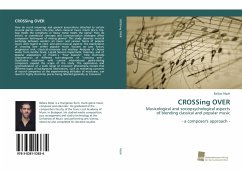
Crossing Over
Sephardic Influences in the Liturgy of Ashkenazi Orthodox Jews of London
Versandkostenfrei!
Versandfertig in 6-10 Tagen
39,99 €
inkl. MwSt.

PAYBACK Punkte
20 °P sammeln!

This book, based on an MA thesis, examines Sephardicmelodies that were adopted into the liturgy ofAshkenazi Jews in London during the early twentiethcentury. The work begins by presenting a history ofSephardic and Ashkenazi Jews from the time theysettled in England to the end of the nineteenthcentury. Through an analysis of social and religiouschanges taking place among English Jews of thenineteenth century, this book explicates reforms inthe synagogue service that led to the inclusion ofpolyphonic music into the synagogue and eventually tothe incorporation of Sephardic melodies intoAshkenazi ...
This book, based on an MA thesis, examines Sephardic
melodies that were adopted into the liturgy of
Ashkenazi Jews in London during the early twentieth
century. The work begins by presenting a history of
Sephardic and Ashkenazi Jews from the time they
settled in England to the end of the nineteenth
century. Through an analysis of social and religious
changes taking place among English Jews of the
nineteenth century, this book explicates reforms in
the synagogue service that led to the inclusion of
polyphonic music into the synagogue and eventually to
the incorporation of Sephardic melodies into
Ashkenazi synagogue practice. The attempt to canonize
the music of Ashkenazi Jews in England was manifested
in the widely successful Handbook of Synagogue Music.
Fifteen melodies of Sephardic origin published in
the Sephardic compilation The Ancient Melodies
(1857), as well as in the Reform hymnal (1880) were
included in the 1899 edition of the Handbook. This
book examines the reasons these Sephardic melodies
were chosen for inclusion by the editors of the
Ashkenazi Handbook during a period of reform.
melodies that were adopted into the liturgy of
Ashkenazi Jews in London during the early twentieth
century. The work begins by presenting a history of
Sephardic and Ashkenazi Jews from the time they
settled in England to the end of the nineteenth
century. Through an analysis of social and religious
changes taking place among English Jews of the
nineteenth century, this book explicates reforms in
the synagogue service that led to the inclusion of
polyphonic music into the synagogue and eventually to
the incorporation of Sephardic melodies into
Ashkenazi synagogue practice. The attempt to canonize
the music of Ashkenazi Jews in England was manifested
in the widely successful Handbook of Synagogue Music.
Fifteen melodies of Sephardic origin published in
the Sephardic compilation The Ancient Melodies
(1857), as well as in the Reform hymnal (1880) were
included in the 1899 edition of the Handbook. This
book examines the reasons these Sephardic melodies
were chosen for inclusion by the editors of the
Ashkenazi Handbook during a period of reform.
Andere Kunden interessierten sich für