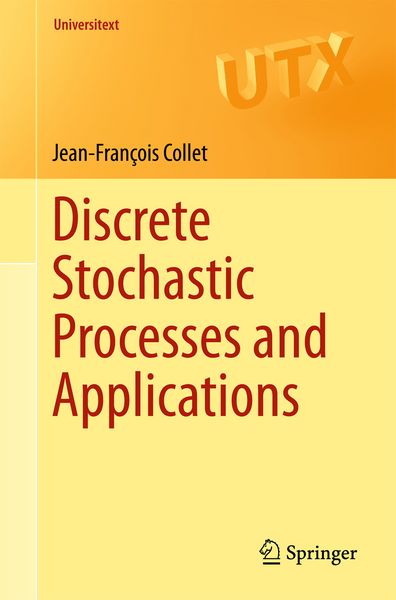
Discrete Stochastic Processes and Applications
-
- Taschenbuch ausgewählt
- eBook
-
Sprache:Englisch
63,99 €
inkl. gesetzl. MwSt.,
Beschreibung
Produktdetails
Einband
Taschenbuch
Erscheinungsdatum
13.04.2018
Abbildungen
XVII, 220 p. 3 illus.
Verlag
SpringerSeitenzahl
220
Maße (L/B/H)
23,5/15,5/1,4 cm
Gewicht
371 g
Auflage
18001 Auflage 1st edition 2018
Sprache
Englisch
ISBN
978-3-319-74017-1
This unique text for beginning graduate students gives a self-contained introduction to the mathematical properties of stochastics and presents their applications to Markov processes, coding theory, population dynamics, and search engine design. The book is ideal for a newly designed course in an introduction to probability and information theory. Prerequisites include working knowledge of linear algebra, calculus, and probability theory. The first part of the text focuses on the rigorous theory of Markov processes on countable spaces (Markov chains) and provides the basis to developing solid probabilistic intuition without the need for a course in measure theory. The approach taken is gradual beginning with the case of discrete time and moving on to that of continuous time. The second part of this text is more applied; its core introduces various uses of convexity in probability and presents a nice treatment of entropy.
Noch keine Bewertungen vorhanden
Verfassen Sie die erste Bewertung zu diesem Artikel
Helfen Sie anderen Kundinnen und Kunden durch Ihre Meinung.
Kurze Frage zu unserer Seite
Vielen Dank für dein Feedback
Wir nutzen dein Feedback, um unsere Produktseiten zu verbessern. Bitte habe Verständnis, dass wir dir keine Rückmeldung geben können. Falls du Kontakt mit uns aufnehmen möchtest, kannst du dich aber gerne an unseren Kund*innenservice wenden.
zum Kundenservice