• Produktbild: Discretization and MCMC Convergence Assessment
  • Produktbild: Discretization and MCMC Convergence Assessment
Band 135

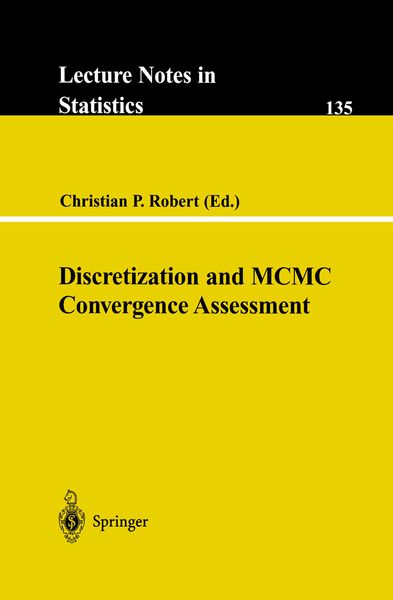
Discretization and MCMC Convergence Assessment

97,99 €

inkl. gesetzl. MwSt., Versandkostenfrei


Beschreibung

Produktdetails

Einband

Taschenbuch

Erscheinungsdatum

13.08.1998

Abbildungen

XI, 192 p. 20 illus.

Herausgeber

Christian P. Robert

Verlag

Springer Us

Seitenzahl

192

Maße (L/B/H)

23,5/15,5/1,2 cm

Gewicht

324 g

Auflage

Softcover reprint of the original 1st ed. 1998

Sprache

Englisch

ISBN

978-0-387-98591-6

Beschreibung

Produktdetails

Einband

Taschenbuch

Erscheinungsdatum

13.08.1998

Abbildungen

XI, 192 p. 20 illus.

Herausgeber

Christian P. Robert

Verlag

Springer Us

Seitenzahl

192

Maße (L/B/H)

23,5/15,5/1,2 cm

Gewicht

324 g

Auflage

Softcover reprint of the original 1st ed. 1998

Sprache

Englisch

ISBN

978-0-387-98591-6

Herstelleradresse

Springer-Verlag GmbH
Tiergartenstr. 17
69121 Heidelberg
DE

Email: ProductSafety@springernature.com

Noch keine Bewertungen vorhanden

Verfassen Sie die erste Bewertung zu diesem Artikel

Helfen Sie anderen Kundinnen und Kunden durch Ihre Meinung.

Kundinnen und Kunden meinen

Bewertungen (0)

  • Produktbild: Discretization and MCMC Convergence Assessment
  • Produktbild: Discretization and MCMC Convergence Assessment
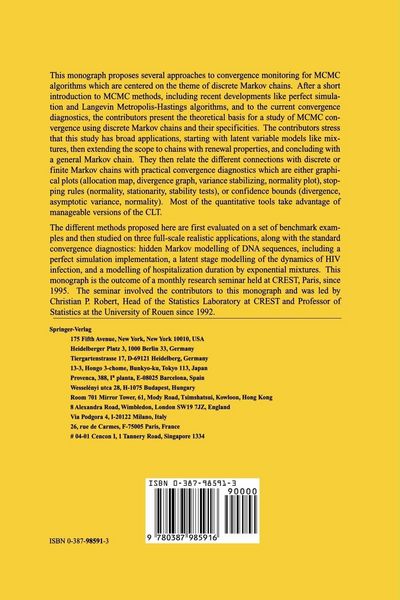
  • 1 Markov Chain Monte Carlo Methods.- 1.1 Motivations.- 1.2 Metropolis-Hastings algorithms.- 1.3 The Gibbs sampler.- 1.4 Perfect sampling.- 1.5 Convergence results from a Duality Principle.- 2 Convergence Control of MCMC Algorithms.- 2.1 Introduction.- 2.2 Convergence assessments for single chains.- 2.3 Convergence assessments based on parallel chains.- 2.4 Coupling techniques.- 3 Linking Discrete and Continuous Chains.- 3.1 Introduction.- 3.2 Rao-Blackwellization.- 3.3 Riemann sum control variates.- 3.4 A mixture example.- 4 Valid Discretization via Renewal Theory.- 4.1 Introduction.- 4.2 Renewal theory and small sets.- 4.3 Discretization of a continuous Markov chain.- 4.4 Convergence assessment through the divergence criterion.- 4.5 Illustration for the benchmark examples.- 4.6 Renewal theory for variance estimation.- 5 Control by the Central Limit Theorem.- 5.1 Introduction.- 5.2 CLT and Renewal Theory.- 5.3 Two control methods with parallel chains.- 5.4 Extension to continuous state chains.- 5.5 Illustration for the benchmark examples.- 5.6 Testing normality on the latent variables.- 6 Convergence Assessment in Latent Variable Models: DNA Applications.- 6.1 Introduction.- 6.2 Hidden Markov model and associated Gibbs sampler.- 6.3 Analysis of thebIL67bacteriophage genome: first convergence diagnostics.- 6.4 Coupling from the past for theM1-M0model.- 6.5 Control by the Central Limit Theorem.- 7 Convergence Assessment in Latent Variable Models: Application to the Longitudinal Modelling of a Marker of HIV Progression.- 7.1 Introduction.- 7.2 Hierarchical Model.- 7.3 Analysis of the San Francisco Men’s Health Study.- 7.4 Convergence assessment.- 8 Estimation of Exponential Mixtures.- 8.1 Exponential mixtures.- 8.2 Convergence evaluation.- References.- Author Index.