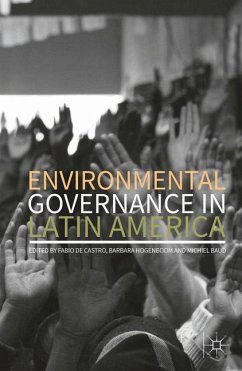

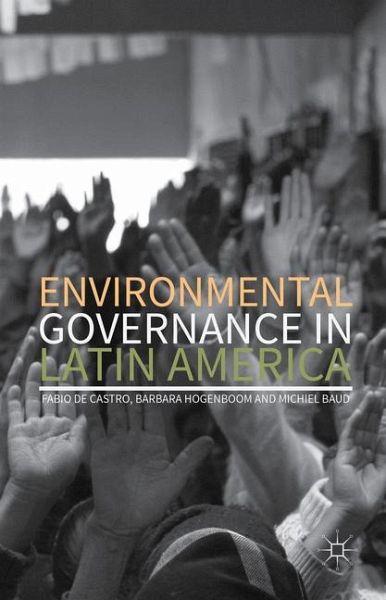
Environmental Governance in Latin America
Versandkostenfrei!
Versandfertig in 6-10 Tagen
21,99 €
inkl. MwSt.

PAYBACK Punkte
11 °P sammeln!

This book is open access under a CC-BY license.
The contributors investigate a broad range of emerging socio-environmental challenges faced by contemporary Latin America. By using environmental governance as an overarching analytical concept, they cross territorial, sectorial, and institutional boundaries to address the nature/society nexus.
The contributors investigate a broad range of emerging socio-environmental challenges faced by contemporary Latin America. By using environmental governance as an overarching analytical concept, they cross territorial, sectorial, and institutional boundaries to address the nature/society nexus.
This book is open access under a CC-BY license.
The multiple purposes of nature - livelihood for communities, revenues for states, commodities for companies, and biodiversity for conservationists - have turned environmental governance in Latin America into a highly contested arena. In such a resource-rich region, unequal power relations, conflicting priorities, and trade-offs among multiple goals have led to a myriad of contrasting initiatives that are reshaping social relations and rural territories. This edited collection addresses these tensions by unpacking environmental governance as a complex process of formulating and contesting values, procedures and practices shaping the access, control and use of natural resources. Contributors from various fields address the challenges, limitations, and possibilities for a more sustainable, equal, and fair development. In this book, environmental governance is seen as an overarching concept defining the dynamic and multi-layered repertoire of society-nature interactions, where images of nature and discourses on the use of natural resources are mediated by contextual processes at multiple scales.
The multiple purposes of nature - livelihood for communities, revenues for states, commodities for companies, and biodiversity for conservationists - have turned environmental governance in Latin America into a highly contested arena. In such a resource-rich region, unequal power relations, conflicting priorities, and trade-offs among multiple goals have led to a myriad of contrasting initiatives that are reshaping social relations and rural territories. This edited collection addresses these tensions by unpacking environmental governance as a complex process of formulating and contesting values, procedures and practices shaping the access, control and use of natural resources. Contributors from various fields address the challenges, limitations, and possibilities for a more sustainable, equal, and fair development. In this book, environmental governance is seen as an overarching concept defining the dynamic and multi-layered repertoire of society-nature interactions, where images of nature and discourses on the use of natural resources are mediated by contextual processes at multiple scales.
Andere Kunden interessierten sich für