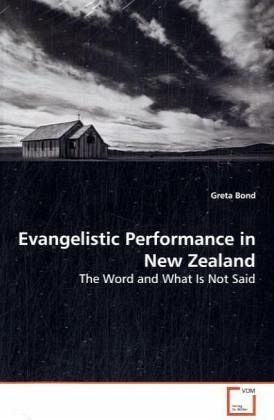
Evangelistic Performance in New Zealand
The Word and What Is Not Said
Versandkostenfrei!
Versandfertig in 6-10 Tagen
52,99 €
inkl. MwSt.

PAYBACK Punkte
26 °P sammeln!

In 1518, Martin Luther is reputed to have nailed his"95 Theses" to the door of the Castle Church at Wittenberg, an actthat sparked the Protestant Reformation. Luther sought change in theCatholic Church: a return to an unmediated relationship withGod based on a direct understanding of the Word. This may be seen asinherently contradictory: the Word is always a translation,especially when used by Protestant evangelists, whose congregations maynot even share a common language. Meanings are produced in theperformance of evangelism - action, music, and the use of space -and influenced by the pre-exi...
In 1518, Martin Luther is reputed to have nailed his
"95 Theses" to
the door of the Castle Church at Wittenberg, an act
that sparked the
Protestant Reformation. Luther sought change in the
Catholic
Church: a return to an unmediated relationship with
God based on a
direct understanding of the Word. This may be seen as
inherently
contradictory: the Word is always a translation,
especially when used
by Protestant evangelists, whose congregations may
not even share
a common language. Meanings are produced in the
performance of
evangelism - action, music, and the use of space -
and influenced
by the pre-existing horizon of expectations of the
congregation.
In New Zealand, Protestant evangelism has gone
hand-in-hand with
colonisation, with significant social impact. This
book undertakes
performance analyses of Samuel Marsden s first
service in New
Zealand in 1814 (in which he preached in English to a
congregation
who primarily spoke only Maori), contemporary
televangelist Benny
Hinn, who performs miracles to television cameras,
and the religious
and political performances of Brian Tamaki, Bishop of
Destiny
Church, New Zealand.
"95 Theses" to
the door of the Castle Church at Wittenberg, an act
that sparked the
Protestant Reformation. Luther sought change in the
Catholic
Church: a return to an unmediated relationship with
God based on a
direct understanding of the Word. This may be seen as
inherently
contradictory: the Word is always a translation,
especially when used
by Protestant evangelists, whose congregations may
not even share
a common language. Meanings are produced in the
performance of
evangelism - action, music, and the use of space -
and influenced
by the pre-existing horizon of expectations of the
congregation.
In New Zealand, Protestant evangelism has gone
hand-in-hand with
colonisation, with significant social impact. This
book undertakes
performance analyses of Samuel Marsden s first
service in New
Zealand in 1814 (in which he preached in English to a
congregation
who primarily spoke only Maori), contemporary
televangelist Benny
Hinn, who performs miracles to television cameras,
and the religious
and political performances of Brian Tamaki, Bishop of
Destiny
Church, New Zealand.
Andere Kunden interessierten sich für