Gutscheinbedingungen

**Gültig vom 15.06.2026 bis 17.06.2026 | Gültig für nicht preisgebundene fremdsprachige Bücher | Einzelne Artikel können ausgeschlossen sein | Maximaler rabattfähiger Warenkorbwert 500 € | Nicht kombinierbar mit weiteren Aktionen | Nur einmal pro Person einlösbar | Nur solange der Vorrat reicht

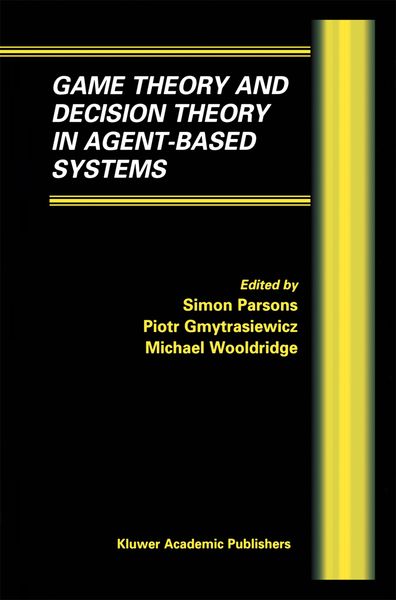
  • Produktbild: Game Theory and Decision Theory in Agent-Based Systems
  • Produktbild: Game Theory and Decision Theory in Agent-Based Systems
Band 5 - 13%

Game Theory and Decision Theory in Agent-Based Systems

13% sparen

185,99 € UVP 213,99 €

inkl. gesetzl. MwSt., Versandkostenfrei

Lieferung nach Hause

Beschreibung

Produktdetails

Einband

Taschenbuch

Erscheinungsdatum

31.10.2012

Herausgeber

Simon D. Parsons + weitere

Verlag

Springer Us

Seitenzahl

379

Maße (L/B/H)

23,5/15,5/2,3 cm

Gewicht

635 g

Auflage

Softcover reprint of the original 1st ed. 2002

Sprache

Englisch

ISBN

978-1-4613-5398-0

Beschreibung

Portrait

Michael Wooldridge is a Professor of Computer Science at the University of Liverpool, UK. He obtained his PhD in 1992 for work in the theory of multiagent systems and has, since then, been active in multiagent systems research.

Produktdetails

Einband

Taschenbuch

Erscheinungsdatum

31.10.2012

Herausgeber

Verlag

Springer Us

Seitenzahl

379

Maße (L/B/H)

23,5/15,5/2,3 cm

Gewicht

635 g

Auflage

Softcover reprint of the original 1st ed. 2002

Sprache

Englisch

ISBN

978-1-4613-5398-0

Herstelleradresse

Springer-Verlag GmbH
Tiergartenstr. 17
69121 Heidelberg
DE

Email: ProductSafety@springernature.com

Kundinnen und Kunden meinen

0 Bewertungen

Informationen zu Bewertungen

Zur Abgabe einer Bewertung ist eine Anmeldung im Konto notwendig. Die Authentizität der Bewertungen wird von uns nicht überprüft. Wir behalten uns vor, Bewertungstexte, die unseren Richtlinien widersprechen, entsprechend zu kürzen oder zu löschen.

Die Bewertungen sind nach Format, Anzahl Sterne und Datum sortiert.

Verfassen Sie die erste Bewertung zu diesem Artikel

Helfen Sie anderen Kund*innen durch Ihre Meinung

Kundinnen und Kunden meinen

0 Bewertungen filtern

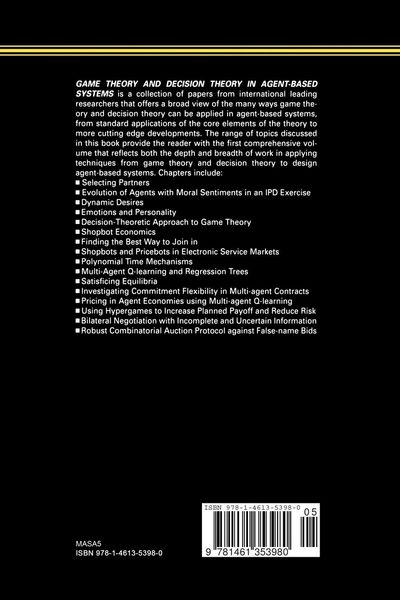
  • Produktbild: Game Theory and Decision Theory in Agent-Based Systems
  • Produktbild: Game Theory and Decision Theory in Agent-Based Systems
  • 1 Game Theory and Decision Theory.- 1 Introduction.- 2 Decision Theory.- 3 Game Theory.- 4 The Prisoner’s Dilemma.- 5 Summary.- 2 Selecting Partners.- 1 Introduction.- 2 A Sample Problem.- 3 Coalition Formation.- 4 Payoff-structures of Partnerships.- 5 Selecting the Potentially most Beneficial Partnership for Limited Interactions.- 6 An Example Evaluation.- 7 Comparative Evaluation with a Decision Mechanism for Infinite Interactions.- 8 Evaluation Scenario.- 9 Experimental Results.- 10 Conclusions.- 3 Evolution of Agents with Moral Sentiments in an IPD Exercise.- 1 Introduction.- 2 Moral Sentiments in the Iterated Prisoner’s Dilemma.- 3 The Unwitting Benefits of Altruism.- 4 An Evolutionary Setting for the Simulations.- 5 Playing with Moral Sentiments Secures the Survival of the Group.- 6 A Case for Benevolence in Agents.- 7 Conclusions.- 4 Dynamic Desires.- 1 Introduction.- 2 Utilities, Desires and Goals.- 3 An Example from Negotiation.- 4 Dynamic Logic.- 5 Future Research.- 6 Concluding Remarks.- 5 Emotions and Personality.- 1 Introduction.- 2 Decision—Theoretic Preliminaries.- 3 Emotional States and Personality.- 4 Conclusions and Future Work.- 5 Acknowledgements.- 6 Decision-Theoretic Approach to Game Theory.- 1 Background on Decision—Theoretic Approach to Game Theory.- 2 Knowledge Base Design.- 3 RMM’s Solution Method.- 4 Rational Communication 109 5 Experiments in Air Defense Domain.- 6 Conclusions.- 7 Shopbot Economics.- 1 Introduction.- 2 Model.- 3 Sellers.- 4 Buyers.- 5 Shopbot.- 6 Related Work.- 7 Conclusions and Future Work.- Appendix: No Pure Strategy Nash Equilibrium.- 8 Finding the Best Way to Join in.- 1 Introduction.- 2 Game Theoretic Foundations.- 3 The Accession Game.- 4 Solving More General Games.- 5 Conclusions.- 9 Shopbots and Pricebots inElectronic Service Markets.- 1 Introduction and Definitions.- 2 Our Model of an Electronic Service Market.- 3 Comparisons.- 4 Related Literature.- 5 Conclusions.- Appendix: The Derivation of Equilibrium for the XX Market Configuration.- 10 Polynomial Time Mechanisms.- 1 Introduction.- 2 Mechanism Design.- 3 Polynomial Time Mechanisms.- 4 Dominant Strategy Implementation.- 5 Nash Implementation.- 6 Upper Bounds on Approximability.- 7 Conclusions.- 11 Multi-Agent Q-learning and Regression Trees.- 1 Introduction.- 2 Model Agent Economies.- 3 Single and Multi-Agent Q-learning.- 4 Q-learning with Regression Trees.- 5 Results.- 6 Conclusions.- 12 Satisficing Equilibria.- 1 Introduction.- 2 A Comparative Paradigm.- 3 Praxeic Utility.- 4 Multi-Agent Systems.- 5 Satisficing Games.- 6 Summary and Discussion.- 13 Investigating Commitment Flexibility in Multi-agent Contracts.- 1 Introduction.- 2 The Scenario.- 3 Some Analysis of Special Cases.- 4 Empirical Work.- 5 Conclusions and Further Work.- 14 Pricing in Agent Economies using Multi-agent Q-learning.- 1 Introduction.- 2 Model Agent Economies.- 3 Single-agent Q-learning.- 4 Multi-agent Q-learning.- 5 Conclusions.- 15 Using Hypergames to Increase Planned Payoff and Reduce Risk.- 1 Introduction.- 2 Discussion.- 3 Results.- 4 Conclusions.- 16 Bilateral Negotiation with Incomplete and Uncertain Information.- 1 Introduction.- 2 The Application Area.- 3 The Negotiation Mechanism.- 4 Evaluation.- 5 Related Work on Negotiation.- 6 Conclusions.- 17 Robust Combinatorial Auction Protocol against False-name Bids.- 1 Introduction.- 2 Generalized Vickrey Auction Protocol (GVA).- 3 Robust Protocol against False-name Bids.- 4 Proof of Incentive Compatibility.- 5 Evaluation.- 6 Discussion.- 7 Conclusions.