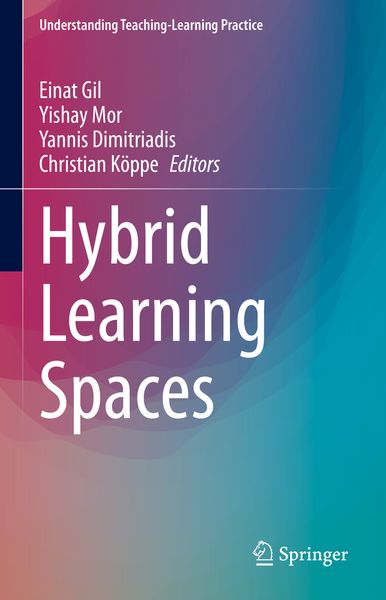
• Produktbild: Hybrid Learning Spaces
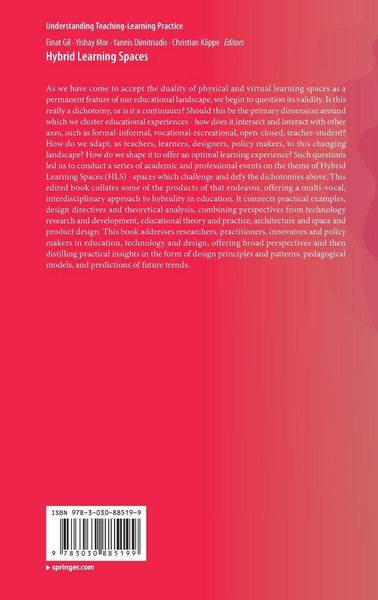
  • Produktbild: Hybrid Learning Spaces
- 10%

Hybrid Learning Spaces

10% sparen

162,99 € UVP 181,89 €

inkl. gesetzl. MwSt., Versandkostenfrei


Beschreibung

Produktdetails

Einband

Gebundene Ausgabe

Erscheinungsdatum

05.02.2022

Abbildungen

XII, 333 p. 67 illus., 57 illus. in color.

Herausgeber

Einat Gil + weitere

Verlag

Springer

Seitenzahl

333

Maße (L/B/H)

24,1/16/2,5 cm

Gewicht

688 g

Auflage

22001 Auflage 1st edition 2022

Sprache

Englisch

ISBN

978-3-030-88519-9

Beschreibung

Portrait


Dr. Einat Gil
is a researcher, designer and leader of innovation processes in teaching & learning. She is the head of the Pedagogical Innovation Spaces project, director of the Center of Innovation and Learning Design and a faculty member at the Kibbutzim College of Education, Technology and the Arts in Tel-Aviv. Previously, she was the Head of Teaching Innovation at Levinsky College of Education, where she led the establishment of Future Learning Spaces and their integration into the college culture as well as additional transformative innovation processes. Formerly, a postdoctoral fellow at the University of Toronto and the Fields Institute for Research in Mathematical Sciences. Her research focuses on teaching and learning in Future & Hybrid Learning Spaces as well as in promoting Statistical reasoning. Dr. Gil consults academic institutions and is a member of the steering committee at MEITAL (IUCEL), an Inter-University Center for eLearning in higher education in Israel. Shehas numerous publications in academic journals, conferences proceeding and learning materials for students and teachers.


Dr. Yishay Mor
is a multi-faceted researcher, entrepreneur and consultant in educational technology and innovation. He is the CTO of EXPEditions, a vibrant Startup on a mission to make the knowledge of the world’s leading experts on critical issues available and accessible to all. He works with educational institutions, NGOs and organisations to lead technology-supported innovation. Dr. Mor founded and led the centre for innovation and excellence in teaching at the Levinsky college of education, and was one of the leaders of the open education challenge - the first pan-European EdTech Startup accelerator. He was a senior lecturer at the British Open University’s Institute of Educational Technology, where, among other things, he led one of the OU’s first MOOCs. Dr. Mor has published over 60 papers (with nearly 3000 citations), and is frequently invited to give keynotes and seminars. He was the editor of eLearning papers. He has co-organised numerous international workshops and conferences, including EduPLoP.dk and the HLS workshop at ECTEL 2019, which contributed to the work presented in this volume.


Dr. Yannis Dimitriadis
is full professor of Telematics Engineering and ex Dean of the Doctoral School, Universidad de Valladolid, Spain. He is also the coordinator of the GSIC/EMIC research group, an interdisciplinary group, integrating over 20 researchers and practitioners from the field of Information and Communications Technologies (ICT) and Pedagogy. He has contributed for more than 25 years in understanding the phenomena, and supporting educational practitioners and technology designers, in carrying out innovations within hybrid modes of learning (e.g., collaborative and inquiry, contexts (e.g., formal and informal) and spaces (e.g., face-to-face, web-based and 3D worlds). His recent research work has focused on learning analytics and smart learning environments, alignment of learning design and learning analytics, design patterns, conceptual and technological support to the orchestration of computer-supported collaborative learning processes, active pedagogies at scale, and across-spaces (Web, 3D worlds and augmented reality) learning. He has participated in more than 50 competitive research projects on technology-enhanced learning, co-authored more than 100 journal papers and 215 conference papers, and organized several workshops and symposia, at ECTEL, CSCL, ISLS, etc. Dr. Dimitriadis is also a senior member of IEEE, member of ISLS, and spent his most recent sabbatical year (2017-2018) at Berkeley, University of Edinburgh, and EPFL.


Christian Köppe
is a researcher, educator and pattern evangelist. His current research is on constructive alignment of graduate level outcomes in long-running assignments, exemplified by IncrementalGrading. He also works at the Freudenthal Institute at Utrecht University as teacher educator with focus on Computer Science Education and as educator at the talent-program ‘U-Talent’ for students of secondary education. Christian is emeritus board member of the Hillside Group, an organization which promotes design patterns as a way of explicating and communicating expert design knowledge in various areas (e.g. educational design). He published more than 50 papers on educational patterns and served as pc-member and co-organizer of several conferences. Christian started, together with Dr. Christian Kohls from TH Cologne, the EduPLoP workshop series, which formed the base for many follow-up publications and projects. The topics of the first two workshops were Assessment Design and Hybrid Pedagogy. The latter workshop also led to the workshop on Hybrid Learning Spaces at the ECTEL conference 2019 and in consequence to the publication of this book. Besides research and education, Christian loves making music (both programmed and hand-made).


Produktdetails

Einband

Gebundene Ausgabe

Erscheinungsdatum

05.02.2022

Abbildungen

XII, 333 p. 67 illus., 57 illus. in color.

Herausgeber

Verlag

Springer

Seitenzahl

333

Maße (L/B/H)

24,1/16/2,5 cm

Gewicht

688 g

Auflage

22001 Auflage 1st edition 2022

Sprache

Englisch

ISBN

978-3-030-88519-9

Herstelleradresse

Springer-Verlag KG
Sachsenplatz 4-6
1201 Wien
AT

Email: ProductSafety@springernature.com

Noch keine Bewertungen vorhanden

Verfassen Sie die erste Bewertung zu diesem Artikel

Helfen Sie anderen Kundinnen und Kunden durch Ihre Meinung.

Kundinnen und Kunden meinen

Bewertungen (0)

Weitere Artikel findest du in

  • Produktbild: Hybrid Learning Spaces
  • Produktbild: Hybrid Learning Spaces

  • Table of contents
    .-
    Chapter 1 Introduction.- Part I: Into the Hybrid.- Chapter 2 Hybrid learning spaces - a three-fold evolving perspective.- Chapter 3 Hyper-hybrid learning spaces in higher education.- Part II: Pedagogy
    .-
    Chapter 4 How co-design can contribute to the ongoing development of hybrid learning spaces by empowering the users.- Chapter 5 H2m pedagogy: Designing for hybrid learning in medical education’.- Chapter 6 Covid-19 lock-down: hybrid learning cases using the lens of the Zone of Possibility.- Chapter 7 Socio-emotional Regulation in Collaborative Hybrid Learning Spaces of Formal–Informal Learning.- Chapter 8 Seamless hybrid science learning: streamlining the techno-pedagogical designs for wider diffusion.- Chapter 9 Designing synchronous hybrid learning spaces: Challenges and opportunities.- Part III: Technology
    .-
    Chapter 10 An analysis of mobile learning tools in terms of pedagogical affordances and support to the learning activity life cycle.- Chapter 11 Classroom Analytics: Telling Stories about Learning Spaces using Sensor Data.- Part IV: Space design
    .-
    Chapter 12 Co-creating futures through virtual ‘BAs’.- Chapter 13 Creativity Flourishes Using Hybrid Spaces Patterns .- Chapter 14 Patterns for a hybrid campus.- Chapter 15 Dialogic teaching and the architecture of hybrid learning spaces: Alexander meets Alexander.- Chapter 16 Design for balance: addressing challenges of safety, privacy and identity management in online and hybridised learning and teaching spaces.- Part V: Concluding
    .-
    Chapter 17 Forward Looking: Predictions for the Future of Hybrid Learning Spaces.