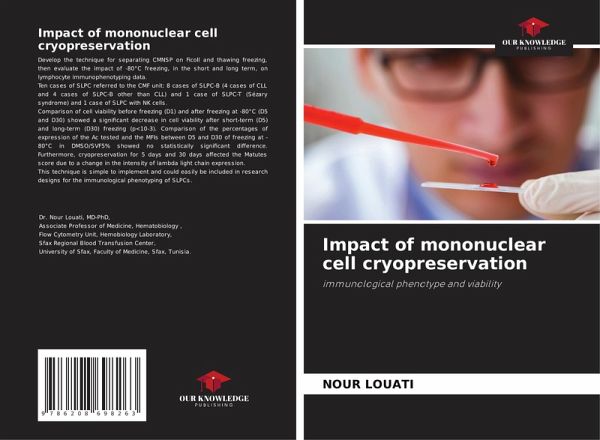
Impact of mononuclear cell cryopreservation
immunological phenotype and viability
Versandkostenfrei!
Versandfertig in 6-10 Tagen
29,99 €
inkl. MwSt.

PAYBACK Punkte
15 °P sammeln!

Develop the technique for separating CMNSP on Ficoll and thawing freezing, then evaluate the impact of -80°C freezing, in the short and long term, on lymphocyte immunophenotyping data.Ten cases of SLPC referred to the CMF unit: 8 cases of SLPC-B (4 cases of CLL and 4 cases of SLPC-B other than CLL) and 1 case of SLPC-T (Sézary syndrome) and 1 case of SLPC with NK cells.Comparison of cell viability before freezing (D1) and after freezing at -80°C (D5 and D30) showed a significant decrease in cell viability after short-term (D5) and long-term (D30) freezing (p
Develop the technique for separating CMNSP on Ficoll and thawing freezing, then evaluate the impact of -80°C freezing, in the short and long term, on lymphocyte immunophenotyping data.Ten cases of SLPC referred to the CMF unit: 8 cases of SLPC-B (4 cases of CLL and 4 cases of SLPC-B other than CLL) and 1 case of SLPC-T (Sézary syndrome) and 1 case of SLPC with NK cells.Comparison of cell viability before freezing (D1) and after freezing at -80°C (D5 and D30) showed a significant decrease in cell viability after short-term (D5) and long-term (D30) freezing (p<10-3). Comparison of the percentages of expression of the Ac tested and the MFIs between D5 and D30 of freezing at -80°C in DMSO/SVF5% showed no statistically significant difference. Furthermore, cryopreservation for 5 days and 30 days affected the Matutes score due to a change in the intensity of lambda light chain expression.This technique is simple to implement and could easily be included in research designs for the immunological phenotyping of SLPCs.
Andere Kunden interessierten sich für