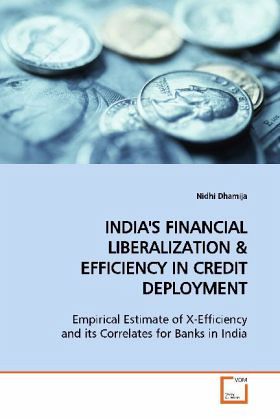
INDIA'S FINANCIAL LIBERALIZATION
Empirical Estimate of X-Efficiency and its Correlates for Banks in India
Versandkostenfrei!
Versandfertig in 6-10 Tagen
39,99 €
inkl. MwSt.

PAYBACK Punkte
20 °P sammeln!

The principal objective of this study is to examine the efficiency of the public sector banks in India for the period of 1986-1999. The main focus of the study is on the cost efficiency of banks and its determinants and also on the examination as to what extent have financial liberalization of early 1990s and the policy reforms led to an improvement in the efficiency levels of the public sector banks. Cost efficient frontier approach is utilized for obtaining the X- efficiency scores. The study employs the translog cost function to estimate the X efficiency (which incorporates both technical a...
The principal objective of this study is to examine
the efficiency of the public sector banks in India
for the period of 1986-1999. The main focus of the
study is on the cost efficiency of banks and its
determinants and also on the examination as to what
extent have financial liberalization of early 1990s
and the policy reforms led to an improvement in the
efficiency levels of the public sector banks. Cost
efficient frontier approach is utilized for
obtaining the X- efficiency scores. The study
employs the translog cost function to estimate the
X efficiency (which incorporates both technical
and allocative efficiency, and hence gives the
overall efficiency) of banks which addresses the
question whether a firm produces as efficiently as
it possibly can, given its size. The conventional
translog cost function plus input share equations
with pooled time-series cross-sectional observations
are used to estimate the stochastic cost frontier
using the parametric approach. In particular, the
study uses the Distribution Free Approach to measure
the X efficiency of banks and hence the findings
rest on the assumptions of DFA method.
the efficiency of the public sector banks in India
for the period of 1986-1999. The main focus of the
study is on the cost efficiency of banks and its
determinants and also on the examination as to what
extent have financial liberalization of early 1990s
and the policy reforms led to an improvement in the
efficiency levels of the public sector banks. Cost
efficient frontier approach is utilized for
obtaining the X- efficiency scores. The study
employs the translog cost function to estimate the
X efficiency (which incorporates both technical
and allocative efficiency, and hence gives the
overall efficiency) of banks which addresses the
question whether a firm produces as efficiently as
it possibly can, given its size. The conventional
translog cost function plus input share equations
with pooled time-series cross-sectional observations
are used to estimate the stochastic cost frontier
using the parametric approach. In particular, the
study uses the Distribution Free Approach to measure
the X efficiency of banks and hence the findings
rest on the assumptions of DFA method.
Andere Kunden interessierten sich für