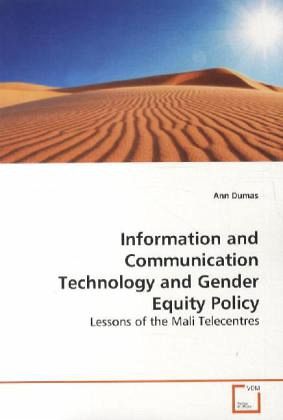
Information and Communication Technology and Gender Equity Policy
Lessons of the Mali Telecentres
Versandkostenfrei!
Versandfertig in 6-10 Tagen
79,00 €
inkl. MwSt.

PAYBACK Punkte
0 °P sammeln!

This work explores the interplay between informationand communication technology (ICT) and the engagementof women in facilitating social, political andeconomic development in traditional poor, rural,communities of Mali, a least developed country. Thisresearch applies international regime theory anddevelopment as freedom theory to help explain how ICTdiffusion with gender equity enhances development forwomen, family and therefore the nation. TheMultipurpose Community Telecentre (MCT) in Timbuktuserves as a model for rural ICT development. Womenparticipated in the design, implementation andopera...
This work explores the interplay between information
and communication technology (ICT) and the engagement
of women in facilitating social, political and
economic development in traditional poor, rural,
communities of Mali, a least developed country. This
research applies international regime theory and
development as freedom theory to help explain how ICT
diffusion with gender equity enhances development for
women, family and therefore the nation. The
Multipurpose Community Telecentre (MCT) in Timbuktu
serves as a model for rural ICT development. Women
participated in the design, implementation and
operation of this MCT. The community open access
design was found to be particularly conducive to ICT
development through women s social networking.
Research indicates women are keepers of indigenous
knowledge systems in cultural communities. The
country data strongly suggest positive and
directional change in Mali during 1990 to 2000, a
period of dynamic telecommunications and gender
equity policy liberalization. This research found ICT
applications helped facilitate positive change in
health, education, politics and the economy in Mali.
and communication technology (ICT) and the engagement
of women in facilitating social, political and
economic development in traditional poor, rural,
communities of Mali, a least developed country. This
research applies international regime theory and
development as freedom theory to help explain how ICT
diffusion with gender equity enhances development for
women, family and therefore the nation. The
Multipurpose Community Telecentre (MCT) in Timbuktu
serves as a model for rural ICT development. Women
participated in the design, implementation and
operation of this MCT. The community open access
design was found to be particularly conducive to ICT
development through women s social networking.
Research indicates women are keepers of indigenous
knowledge systems in cultural communities. The
country data strongly suggest positive and
directional change in Mali during 1990 to 2000, a
period of dynamic telecommunications and gender
equity policy liberalization. This research found ICT
applications helped facilitate positive change in
health, education, politics and the economy in Mali.
Andere Kunden interessierten sich für