
Andere Kunden interessierten sich auch für
 Capillary flow reactor for dye-assisted solar photochemical reactions44,99 €
 Photochemical oxidation of some carbohydrates28,99 €
 Photochemical oxidation28,99 €
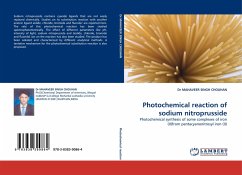
 Photochemical reaction of sodium nitroprusside42,99 €
 Photochemical Reaction24,99 €
 Essentials of Pericyclic and Photochemical Reactions98,99 €
 Photochemical Logic Gate24,99 €
Non-Markovian (memory function) chemical kinetics
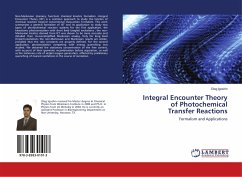
formalism -Integral Encounter Theory (IET) is a
common approach to study the kinetics of chemical
reaction beyond conventional mass-action formalism.
This work summarizes a general formalism of IET and
its application to study two types of photochemical
reaction systems. For the first application, the
biexcitonic photoionization with short lived (singlet)
excitations , the non-Markovian kinetics derived
from IET was shown to be more accurate and detailed
than its oversimplified Markovian analog. Only for
long lived (triplet) excitations the non-Markovian
and Markovian results are similar, provided that the
rate constants
are properly defined. For the second application,
photooxidation competing with energy quenching was
studied. We obtained the stationary concentration of
the free carriers, with account of their geminate
recombination before separation, as well as the
stationary rate of singlet oxygen generation,
affected by preliminary quenching of nearest
excitations in the course of ionization.
formalism -Integral Encounter Theory (IET) is a
common approach to study the kinetics of chemical
reaction beyond conventional mass-action formalism.
This work summarizes a general formalism of IET and
its application to study two types of photochemical
reaction systems. For the first application, the
biexcitonic photoionization with short lived (singlet)
excitations , the non-Markovian kinetics derived
from IET was shown to be more accurate and detailed
than its oversimplified Markovian analog. Only for
long lived (triplet) excitations the non-Markovian
and Markovian results are similar, provided that the
rate constants
are properly defined. For the second application,
photooxidation competing with energy quenching was
studied. We obtained the stationary concentration of
the free carriers, with account of their geminate
recombination before separation, as well as the
stationary rate of singlet oxygen generation,
affected by preliminary quenching of nearest
excitations in the course of ionization.