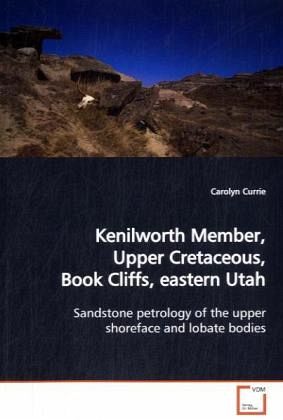
Kenilworth Member, Upper Cretaceous, Book Cliffs, eastern Utah
Sandstone petrology of the upper shoreface and lobate bodies
Versandkostenfrei!
Versandfertig in 6-10 Tagen
32,99 €
inkl. MwSt.

PAYBACK Punkte
16 °P sammeln!

The Book Cliffs of eastern Utah contain some of thebest exposures to shallow marine strata in the world. The cliffs extend almost continuously for 300 kmfrom Helper, Utah to Grand Junction in Colorado. Along these cliffs are numerous canyons which haveprovided researchers with an excellent threedimensional image of the geology that has beenexposed. Within these strata two clastic wedges havebeen identified: the Star Point Formation and theBlackhawk Formation. The Blackhawk Formation containssix members, of which the Kenilworth Member is thefocus of this work. Through a petrographic study, itwa...
The Book Cliffs of eastern Utah contain some of the
best exposures to shallow marine strata in the world.
The cliffs extend almost continuously for 300 km
from Helper, Utah to Grand Junction in Colorado.
Along these cliffs are numerous canyons which have
provided researchers with an excellent three
dimensional image of the geology that has been
exposed. Within these strata two clastic wedges have
been identified: the Star Point Formation and the
Blackhawk Formation. The Blackhawk Formation contains
six members, of which the Kenilworth Member is the
focus of this work. Through a petrographic study, it
was noted that moving down-dip on the shoreface the
grain size decreased as well as the quartz content.
These trends support the expected transition from a
sand-rich shoreface environment to a mud-rich shelf
environment. The shelf bodies are anomalous sand-rich
lenses or lobate bodies completely encased in shelf
mudstones. The origin of these bodies is still under
debate but petrographically these bodies are similar
to the lower attached shoreface sandstones and
support both the detached shoreface hypothesis and
subaqueous channels hypothesis proposed by Pattison
(2006).
best exposures to shallow marine strata in the world.
The cliffs extend almost continuously for 300 km
from Helper, Utah to Grand Junction in Colorado.
Along these cliffs are numerous canyons which have
provided researchers with an excellent three
dimensional image of the geology that has been
exposed. Within these strata two clastic wedges have
been identified: the Star Point Formation and the
Blackhawk Formation. The Blackhawk Formation contains
six members, of which the Kenilworth Member is the
focus of this work. Through a petrographic study, it
was noted that moving down-dip on the shoreface the
grain size decreased as well as the quartz content.
These trends support the expected transition from a
sand-rich shoreface environment to a mud-rich shelf
environment. The shelf bodies are anomalous sand-rich
lenses or lobate bodies completely encased in shelf
mudstones. The origin of these bodies is still under
debate but petrographically these bodies are similar
to the lower attached shoreface sandstones and
support both the detached shoreface hypothesis and
subaqueous channels hypothesis proposed by Pattison
(2006).
Andere Kunden interessierten sich für