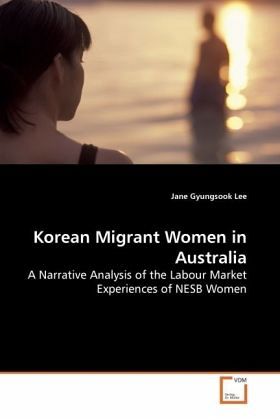
Korean Migrant Women in Australia
A Narrative Analysis of the Labour Market Experiences of NESB Women
Versandkostenfrei!
Versandfertig in 6-10 Tagen
52,99 €
inkl. MwSt.

PAYBACK Punkte
26 °P sammeln!

The Korean migrant woman who does not speak Englishis rendered silent and incommunicado. Little furtherjustification is required for her lack of inclusionin mainstream society of which the labour marketfeatures. Labour market participation is a form ofsymbolic interaction that is manifested byacceptance, financial reward and the granting ofparticular working conditions and opportunities. Thefunction of communication, here the English language,is concealed as a measurable and necessary skill, andoperates to permit or prevent entry into theAustralian labour market organisation.Even where entry i...
The Korean migrant woman who does not speak English
is rendered silent and incommunicado. Little further
justification is required for her lack of inclusion
in mainstream society of which the labour market
features. Labour market participation is a form of
symbolic interaction that is manifested by
acceptance, financial reward and the granting of
particular working conditions and opportunities. The
function of communication, here the English language,
is concealed as a measurable and necessary skill, and
operates to permit or prevent entry into the
Australian labour market organisation.
Even where entry is allowed and the Korean woman
appears to be accepted, the lack of substantive and
total inclusion, recognition and opportunities ensure
that the Korean woman is constantly reminded that she
is marginalised, at some distance from the dominant
Australian English-speaking culture. The dominant
culture, as Bourdieu (1991) describes, measures
different subcultures in terms of distance from
itself, creating a hierarchy based upon proximity.
This hierarchy is expressed through the exclusion or
inclusion of people at designated levels in the
labour market organisation.
is rendered silent and incommunicado. Little further
justification is required for her lack of inclusion
in mainstream society of which the labour market
features. Labour market participation is a form of
symbolic interaction that is manifested by
acceptance, financial reward and the granting of
particular working conditions and opportunities. The
function of communication, here the English language,
is concealed as a measurable and necessary skill, and
operates to permit or prevent entry into the
Australian labour market organisation.
Even where entry is allowed and the Korean woman
appears to be accepted, the lack of substantive and
total inclusion, recognition and opportunities ensure
that the Korean woman is constantly reminded that she
is marginalised, at some distance from the dominant
Australian English-speaking culture. The dominant
culture, as Bourdieu (1991) describes, measures
different subcultures in terms of distance from
itself, creating a hierarchy based upon proximity.
This hierarchy is expressed through the exclusion or
inclusion of people at designated levels in the
labour market organisation.
Andere Kunden interessierten sich für