Versandkostenfrei!
Versandfertig in 6-10 Tagen
Weitere Ausgaben:
PAYBACK Punkte
19 °P sammeln!
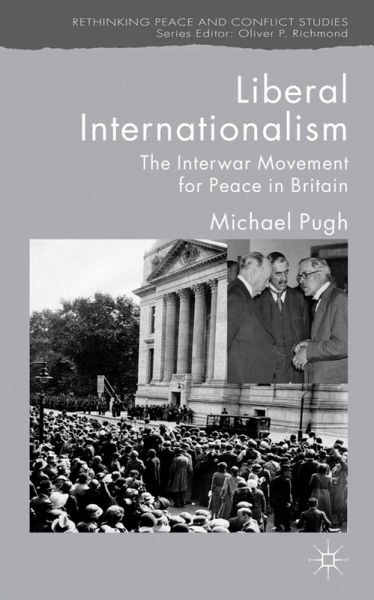
The book investigates the role of popular liberal internationalism as a social movement in Britain using Gramscian and Foucauldian ideas of civil society. It addresses the use of force for peace through an examination of the impact of civil society actors in popular liberal internationalism between the world wars.
MICHAEL PUGH is Professor of Peace and Conflict Studies, University of Bradford, UK, Leverhulme Emeritus Fellow (2011-12) and editor of the journal International Peacekeeping. He has written extensively on peace and conflict and is the co-editor, with Neil Cooper and Mandy Turner, of Whose Peace? Critical Perspectives on the Political Economy of Peacebuilding (Palgrave Macmillan, 2008).
Produktdetails
- Rethinking Peace and Conflict Studies
- Verlag: Palgrave Macmillan / Palgrave Macmillan UK / Springer Palgrave Macmillan
- Artikelnr. des Verlages: 978-0-230-53763-7
- 2012 edition
- Seitenzahl: 244
- Erscheinungstermin: 28. September 2012
- Englisch
- Abmessung: 216mm x 145mm x 20mm
- Gewicht: 448g
- ISBN-13: 9780230537637
- ISBN-10: 0230537634
- Artikelnr.: 33252990
Herstellerkennzeichnung
Libri GmbH
Europaallee 1
36244 Bad Hersfeld
gpsr@libri.de
"In this excellent book, Pugh very clearly establishes the role and significance of social and political movements in the development of foreign and defence policy [...] I commend this book to all who want to understand why peace movements
and other social movements for progressive social change are important." - International Peacekeeping
'With impeccable scholarship, Michael Pugh offers novel insights into interwar liberal internationalism in Britain. Erudite and authoritative, this account will rightly become an indispensable point of reference for students and scholars alike.'
- Richard Caplan, Professor of International Relations, University of Oxford, UK
'This is an important and erudite book. The
and other social movements for progressive social change are important." - International Peacekeeping
'With impeccable scholarship, Michael Pugh offers novel insights into interwar liberal internationalism in Britain. Erudite and authoritative, this account will rightly become an indispensable point of reference for students and scholars alike.'
- Richard Caplan, Professor of International Relations, University of Oxford, UK
'This is an important and erudite book. The
Mehr anzeigen
1930s are often seen as a 'lost decade' in
which appeasement led inevitably to the Second World War. Michael Pugh's careful
reading of the period reveals a much more complex story in which peace movements
had considerable success in laying down the foundations of what would later become
the rationale for international peace-support interventions and collective security.
This work is a useful antidote to many of the a-historical books on international
relations that assume the world began in 1989.'
Roger Mac Ginty, Professor of Peace and Conflict Studies, University of Manchester, UK
'Michael Pugh has produced a compelling, thought-provoking and highly readable assessment of the importance and lasting impact of interwar 'liberal internationalism' as a 'complex movement at once humane and superior, tolerant and dogmatic, universalistic and imperial'. While many of its leading intellectual proponents were later denigrated as hopelessly 'naïve' and 'idealistic', Pugh reveals a movement not only with a strong ethical dimension but one capable of 'pragmatic adaption to changes in international and domestic circumstances'. Above all, this is a study of liberal internationalism as an influential, if diverse and complex, social movement for peace. As such, and as Pugh persuasively shows, any assessment of its true impact and influence requires a longer-term historical perspective, one that extends well beyond the interwar period itself.'
- Mats Berdal, King's College London, UK
which appeasement led inevitably to the Second World War. Michael Pugh's careful
reading of the period reveals a much more complex story in which peace movements
had considerable success in laying down the foundations of what would later become
the rationale for international peace-support interventions and collective security.
This work is a useful antidote to many of the a-historical books on international
relations that assume the world began in 1989.'
Roger Mac Ginty, Professor of Peace and Conflict Studies, University of Manchester, UK
'Michael Pugh has produced a compelling, thought-provoking and highly readable assessment of the importance and lasting impact of interwar 'liberal internationalism' as a 'complex movement at once humane and superior, tolerant and dogmatic, universalistic and imperial'. While many of its leading intellectual proponents were later denigrated as hopelessly 'naïve' and 'idealistic', Pugh reveals a movement not only with a strong ethical dimension but one capable of 'pragmatic adaption to changes in international and domestic circumstances'. Above all, this is a study of liberal internationalism as an influential, if diverse and complex, social movement for peace. As such, and as Pugh persuasively shows, any assessment of its true impact and influence requires a longer-term historical perspective, one that extends well beyond the interwar period itself.'
- Mats Berdal, King's College London, UK

Schließen
Für dieses Produkt wurde noch keine Bewertung abgegeben. Wir würden uns sehr freuen, wenn du die erste Bewertung schreibst!
Eine Bewertung schreiben
Andere Kunden interessierten sich für