Gutscheinbedingungen

**Gültig vom 07.09.2026 bis 09.09.2026 | Gültig für nicht preisgebundene fremdsprachige Bücher | Einzelne Artikel können ausgeschlossen sein | Online auf www.bücher.de einlösbar | Click & Collect nur mit Online-Zahlung (Paypal/Kreditkarte) vorab | Nicht kombinierbar mit anderen Gutscheinen oder Preisaktionen | Nur einmal pro Einkauf einlösbar | Gutschein wird auf max. 500€ Bestellwert angerechnet | Keine Barauszahlung | Nicht gültig für Versandkosten und Services

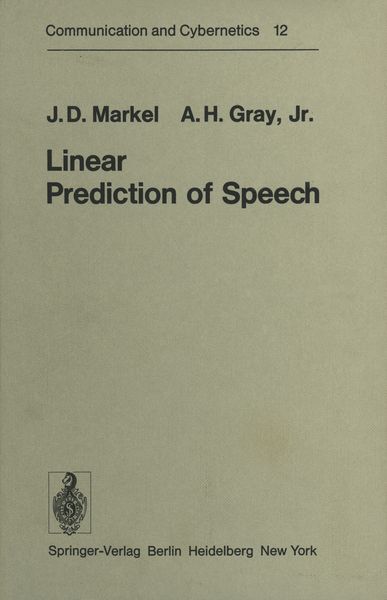
Produktbild: Linear Prediction of Speech
Band 12

Linear Prediction of Speech

97,99 €

inkl. gesetzl. MwSt., Versandkostenfrei


Beschreibung

Produktdetails

Einband

Taschenbuch

Erscheinungsdatum

15.11.2011

Abbildungen

XII, 290 p.

Verlag

Springer Berlin

Seitenzahl

290

Maße (L/B/H)

24,4/17/1,7 cm

Gewicht

528 g

Auflage

Softcover reprint of the original 1st ed. 1976

Sprache

Englisch

ISBN

978-3-642-66288-1

Beschreibung

Produktdetails

Einband

Taschenbuch

Erscheinungsdatum

15.11.2011

Abbildungen

XII, 290 p.

Verlag

Springer Berlin

Seitenzahl

290

Maße (L/B/H)

24,4/17/1,7 cm

Gewicht

528 g

Auflage

Softcover reprint of the original 1st ed. 1976

Sprache

Englisch

ISBN

978-3-642-66288-1

Herstelleradresse

Springer-Verlag KG
Sachsenplatz 4-6
1201 Wien
AT

Email: ProductSafety@springernature.com

Noch keine Bewertungen vorhanden

Verfassen Sie die erste Bewertung zu diesem Artikel

Helfen Sie anderen Kundinnen und Kunden durch Ihre Meinung.

Kundinnen und Kunden meinen

Bewertungen (0)

  • Produktbild: Linear Prediction of Speech
  • 1. Introduction.- 1.1 Basic Physical Principles.- 1.2 Acoustical Waveform Examples.- 1.3 Speech Analysis and Synthesis Models.- 1.4 The Linear Prediction Model.- 1.5 Organization of Book.- 2. Formulations.- 2.1 Historical Perspective.- 2.2 Maximum Likelihood.- 2.3 Minimum Variance.- 2.4 Prony’s Method.- 2.5 Correlation Matching.- 2.6 PARCOR (Partial Correlation).- 3. Solutions and Properties.- 3.1 Introduction.- 3.2 Vector Spaces and Inner Products.- 3.3 Solution Algorithms.- 3.4 Matrix Forms.- 4. Acoustic Tube Modeling.- 4.1 Introduction.- 4.2 Acoustic Tube Derivation.- 4.3 Relationship between Acoustic Tube and Linear Prediction.- 4.4 An Algorithm, Examples, and Evaluation.- 4.5 Estimation of Lip Impedance.- 4.6 Further Topics.- 5. Speech Synthesis Structures.- 5.1 Introduction.- 5.2 Stability.- 5.3 Recursive Parameter Evaluation.- 5.4 A General Synthesis Structure.- 5.5 Specific Speech Synthesis Structures.- 6. Spectral Analysis.- 6.1 Introduction.- 6.2 Spectral Properties.- 6.3 A Spectral Flatness Model.- 6.4 Selective Linear Prediction.- 6.5 Considerations in Choice of Analysis Conditions.- 6.6 Spectral Evaluation Techniques.- 6.7 Pole Enhancement.- 7. Automatic Formant Trajectory Estimation.- 7.1 Introduction.- 7.2 Formant Trajectory Estimation Procedure.- 7.3 Comparison of Raw Data from Linear Prediction and Cepstral Smoothing.- 7.4 Algorithm 1.- 7.5 Algorithm 2.- 7.6 Formant Estimation Accuracy.- 8. Fundamental Frequency Estimation.- 8.1 Introduction.- 8.2 Preprocessing by Spectral Flattening.- 8.3 Correlation Techniques.- 9. Computational Considerations in Analysis.- 9.1 Introduction.- 9.2 Ill-Conditioning.- 9.3 Implementing Linear Prediction Analysis.- 9.4 Finite Word Length Considerations.- 10. Vocoders.- 10.1 Introduction.- 10.2 Techniques.- 10.3 Low BitRate Pitch Excited Vocoders.- 10.4 Base-Band Excited Vocoders.- 11. Further Topics.- 11.1 Speaker Identification and Verification.- 11.2 Isolated Word Recognition.- 11.3 Acoustical Detection of Laryngeal Pathology.- 11.4 Pole-Zero Estimation.- 11.5 Summary and Future Directions.- References.