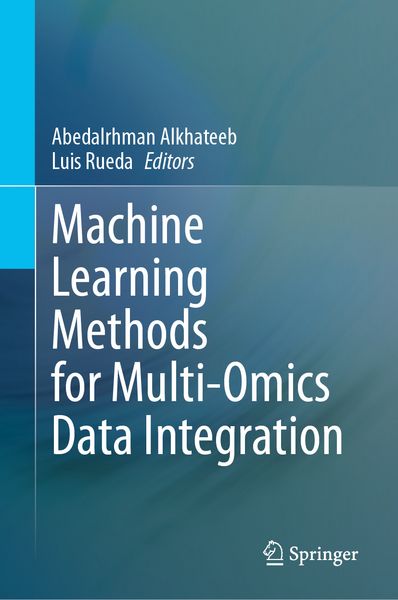
Machine Learning Methods for Multi-Omics Data Integration
-
- Hardcover ausgewählt
- Taschenbuch
- eBook
-
Sprache:Englisch
189,99 €
UVP
235,39 €
inkl. gesetzl. MwSt.,
Beschreibung
Produktdetails
Einband
Gebundene Ausgabe
Erscheinungsdatum
14.11.2023
Abbildungen
VI, 168 p. 32 illus., 30 illus. in color.
Herausgeber
Abedalrhman Alkhateeb + weitereVerlag
SpringerSeitenzahl
168
Maße (L/B/H)
24,1/16/1,6 cm
Gewicht
436 g
Auflage
23001 Auflage 1st edition 2024
Sprache
Englisch
ISBN
978-3-031-36501-0
The advancement of biomedical engineering has enabled the generation of multi-omics data by developing high-throughput technologies, such as next-generation sequencing, mass spectrometry, and microarrays. Large-scale data sets for multiple omics platforms, including genomics, transcriptomics, proteomics, and metabolomics, have become more accessible and cost-effective over time. Integrating multi-omics data has become increasingly important in many research fields, such as bioinformatics, genomics, and systems biology. This integration allows researchers to understand complex interactions between biological molecules and pathways. It enables us to comprehensively understand complex biological systems, leading to new insights into disease mechanisms, drug discovery, and personalized medicine. Still, integrating various heterogeneous data types into a single learning model also comes with challenges. In this regard, learning algorithms have been vital in analyzing and integratingthese large-scale heterogeneous data sets into one learning model.
This book overviews the latest multi-omics technologies, machine learning techniques for data integration, and multi-omics databases for validation. It covers different types of learning for supervised and unsupervised learning techniques, including standard classifiers, deep learning, tensor factorization, ensemble learning, and clustering, among others. The book categorizes different levels of integrations, ranging from early, middle, or late-stage among multi-view models. The underlying models target different objectives, such as knowledge discovery, pattern recognition, disease-related biomarkers, and validation tools for multi-omics data.
Finally, the book emphasizes practical applications and case studies, making it an essential resource for researchers and practitioners looking to apply machine learning to their multi-omics data sets. The book covers data preprocessing, feature selection, and model evaluation, providing readers with a practical guide to implementing machine learning techniques on various multi-omics data sets.
Noch keine Bewertungen vorhanden
Verfassen Sie die erste Bewertung zu diesem Artikel
Helfen Sie anderen Kundinnen und Kunden durch Ihre Meinung.
Kurze Frage zu unserer Seite
Vielen Dank für dein Feedback
Wir nutzen dein Feedback, um unsere Produktseiten zu verbessern. Bitte habe Verständnis, dass wir dir keine Rückmeldung geben können. Falls du Kontakt mit uns aufnehmen möchtest, kannst du dich aber gerne an unseren Kund*innenservice wenden.
zum Kundenservice