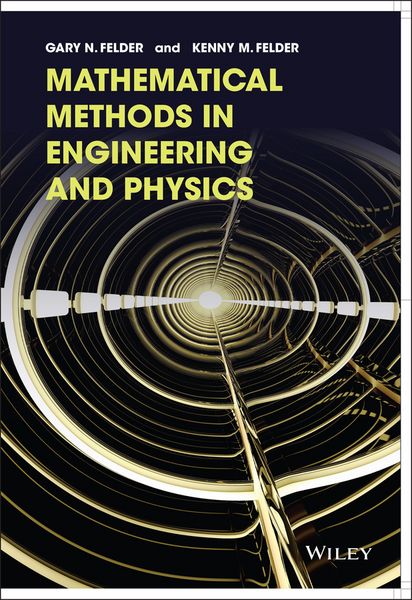
Produktbild: Mathematical Methods in Engineering and Physics

Mathematical Methods in Engineering and Physics

214,99 €

inkl. gesetzl. MwSt., Versandkostenfrei


Beschreibung

Produktdetails

Einband

Taschenbuch

Erscheinungsdatum

13.04.2015

Verlag

John Wiley & Sons Inc

Seitenzahl

832

Maße (L/B/H)

25,4/17,7/2,7 cm

Gewicht

1142 g

Sprache

Englisch

ISBN

978-1-118-44960-8

Beschreibung

Rezension

"[Mathematical Methods in Engineering and Physics] is my book of choice for teaching undergraduates...I honestly never thought that I could be so enchanted by the heat equation before seeing how Felder and Felder effectively have students derive it as part of honing their intuition for how to think about partial differential equations." - Christine Aidala, PhD, Associate Professor of Physics at University of Michigan for the American Journal of Physics

Produktdetails

Einband

Taschenbuch

Erscheinungsdatum

13.04.2015

Verlag

John Wiley & Sons Inc

Seitenzahl

832

Maße (L/B/H)

25,4/17,7/2,7 cm

Gewicht

1142 g

Sprache

Englisch

ISBN

978-1-118-44960-8

Herstelleradresse

Libri GmbH
Europaallee 1
36244 Bad Hersfeld
DE

Email: gpsr@libri.de

Noch keine Bewertungen vorhanden

Verfassen Sie die erste Bewertung zu diesem Artikel

Helfen Sie anderen Kundinnen und Kunden durch Ihre Meinung.

Kundinnen und Kunden meinen

Bewertungen (0)

  • Produktbild: Mathematical Methods in Engineering and Physics
  • Preface xi

    1 Introduction to Ordinary Differential Equations 1

    1.1 Motivating Exercise: The Simple Harmonic Oscillator 2

    1.2 Overview of Differential Equations 3

    1.3 Arbitrary Constants 15

    1.4 Slope Fields and Equilibrium 25

    1.5 Separation of Variables 34

    1.6 Guess and Check, and Linear Superposition 39

    2 Taylor Series and Series Convergence 50

    2.1 Motivating Exercise: Vibrations in a Crystal 51

    2.2 Linear Approximations 52

    2.3 Maclaurin Series 60

    2.4 Taylor Series 70

    2.5 Finding One Taylor Series from Another 76

    2.6 Sequences and Series 80

    2.7 Tests for Series Convergence 92

    3 Complex Numbers 104

    3.1 Motivating Exercise: The Underdamped Harmonic Oscillator 104

    3.2 Complex Numbers 105

    3.3 The Complex Plane 113

    3.4 Euler's Formula I-The Complex Exponential Function 117

    3.5 Euler's Formula II-Modeling Oscillations 126

    4 Partial Derivatives 136

    4.1 Motivating Exercise: The Wave Equation 136

    4.2 Partial Derivatives 137

    4.3 The Chain Rule 145

    4.4 Implicit Differentiation 153

    4.5 Directional Derivatives 158

    4.6 The Gradient 163

    4.8 Optimization and the Gradient 172

    4.9 Lagrange Multipliers 181

    5 Integrals in Two or More Dimensions 188

    5.1 Motivating Exercise: Newton's Problem (or) The Gravitational Field of a Sphere 188

    5.2 Setting Up Integrals 189

    5.3 Cartesian Double Integrals over a Rectangular Region 204

    5.4 Cartesian Double Integrals over a Non-Rectangular Region 211

    5.5 Triple Integrals in Cartesian Coordinates 216

    5.6 Double Integrals in Polar Coordinates 221

    5.7 Cylindrical and Spherical Coordinates 229

    5.8 Line Integrals 240

    5.9 Parametrically Expressed Surfaces 249

    5.10 Surface Integrals 253

    6 Linear Algebra I 266

    6.1 The Motivating Example on which We're Going to Base the Whole Chapter: The Three-Spring Problem 266

    6.2 Matrices: The Easy Stuff 276

    6.3 Matrix Times Column 280

    6.4 Basis Vectors 286

    6.5 Matrix Times Matrix 294

    6.6 The Identity and Inverse Matrices 303

    6.7 Linear Dependence and the Determinant 312

    6.8 Eigenvectors and Eigenvalues 325

    6.9 Putting It Together: Revisiting the Three-Spring Problem 336

    7 Linear Algebra II 346

    7.1 Geometric Transformations 347

    7.2 Tensors 358

    7.3 Vector Spaces and Complex Vectors 369

    8 Vector Calculus 378

    8.1 Motivating Exercise: Flowing Fluids 378

    8.2 Scalar and Vector Fields 379

    8.3 Potential in One Dimension 387

    8.4 From Potential to Gradient 396

    8.5 From Gradient to Potential: The Gradient Theorem 402

    8.6 Divergence, Curl, and Laplacian 407

    8.7 Divergence and Curl II-The Math Behind the Pictures 416

    8.8 Vectors in Curvilinear Coo