KI-Beratung Beta

Gutscheinbedingungen

**Gültig vom 23.11. bis 30.11.2026 | Gültig für nicht preisgebundene fremdsprachige Bücher | Einzelne Artikel können ausgeschlossen sein | Online auf www.bücher.de einlösbar | Click & Collect nur mit Online-Zahlung (Paypal/Kreditkarte) vorab | Nicht kombinierbar mit anderen Gutscheinen oder Preisaktionen | Nur einmal pro Einkauf einlösbar | Gutschein wird auf max. 500€ Bestellwert angerechnet | Keine Barauszahlung | Nicht gültig für Versandkosten und Services

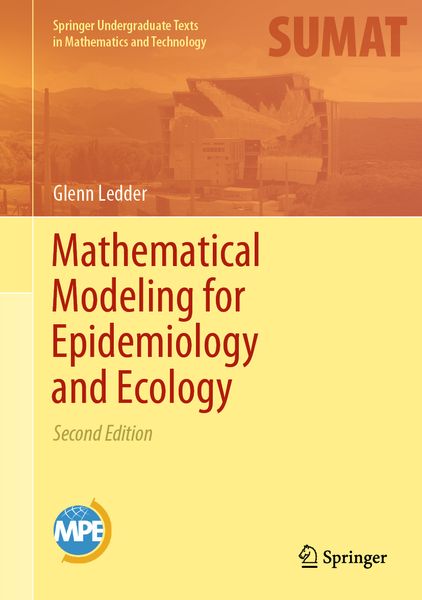
Produktbild: Mathematical Modeling for Epidemiology and Ecology

Mathematical Modeling for Epidemiology and Ecology

53,99 €

inkl. gesetzl. MwSt., Versandkostenfrei


Beschreibung

Mathematical Modeling for Epidemiology and Ecology provides readers with the mathematical tools needed to understand and use mathematical models and read advanced mathematical biology books.  It presents mathematics in biological contexts, focusing on the central mathematical ideas and the biological...

Beschreibung

Mathematical Modeling for Epidemiology and Ecology provides readers with the mathematical tools needed to understand and use mathematical models and read advanced mathematical biology books.  It presents mathematics in biological contexts, focusing on the central mathematical ideas and the biological implications, with detailed explanations. The author assumes no mathematics background beyond elementary differential calculus. 

An introductory chapter on basic principles of mathematical modeling is followed by chapters on empirical modeling and mechanistic modeling. These chapters contain a thorough treatment of key ideas and techniques that are often neglected in mathematics books, such as the Akaike Information Criterion. The second half of the book focuses on analysis of dynamical systems, emphasizing tools to simplify analysis, such as the Routh-Hurwitz conditions and asymptotic analysis. Courses can be focused on either half of the book or thematically chosen material from both halves, such as a course on mathematical epidemiology.

The biological content is self-contained and includes many topics in epidemiology and ecology. Some of this material appears in case studies that focus on a single detailed example, and some is based on recent research by the author on vaccination modeling and scenarios from the COVID-19 pandemic.

The problem sets feature linked problems where one biological setting appears in multi-step problems that are sorted into the appropriate section, allowing readers to gradually develop complete investigations of topics such as HIV immunology and harvesting of natural resources.  Some problems use programs written by the author for Matlab or Octave; these combine with more traditional mathematical exercises to give students a full set of tools for model analysis. Each chapter contains additional case studies in the form of projects with detailed directions.  New appendices contain mathematical details on optimization, numerical solution of differential equations, scaling, linearization, and sophisticated use of elementary algebra to simplify problems.


Rezension

“This lovely book is referred to as the second edition of Mathematical Modeling for Epidemiology and Ecology. … The book is written with exceptional care and attention to detail, the presentation is very friendly and precise. … The second edition of Mathematical Modeling for Epidemiology and Ecology can be used in many forms, both as a textbook for a specialized course and as a supplement to a wide variety of courses … .” (Yuriy V. Rogovchenko, zbMATH 1534.92002, 2024)


“This is a well-written book, highly suitable for applied math undergraduate students.” (Stephanie Abo, Chi-Chung Cheung, Ryth Dasgupta, Pritha Dutta, Shervin Hakimi, Amandeep Kaur, Anita T. Layton, Mehrshad Sadria, Melissa Stadt, Vasu Swaroop and Kaixin Zheng)

Produktdetails

Einband

Gebundene Ausgabe

Erscheinungsdatum

15.04.2023

Abbildungen

XIX, 364 p. 88 illus., 61 illus. in color.

Verlag Springer

Produktdetails

Einband

Gebundene Ausgabe

Erscheinungsdatum

15.04.2023

Abbildungen

XIX, 364 p. 88 illus., 61 illus. in color.

Verlag Springer
Seitenzahl

364

Maße (L/B/H)

26/18,3/2,6 cm

Gewicht

948 g

Auflage

Second Edition 2023

Sprache

Englisch

ISBN

978-3-031-09453-8

Herstelleradresse

Springer-Verlag GmbH
Europaplatz 3
69115 Heidelberg
DE

Email: ProductSafety@springernature.com

Noch keine Bewertungen vorhanden

Verfassen Sie die erste Bewertung zu diesem Artikel

Helfen Sie anderen Kundinnen und Kunden durch Ihre Meinung.

Kundinnen und Kunden meinen

Bewertungen (0)

  • Produktbild: Mathematical Modeling for Epidemiology and Ecology

  • Part I Mathematical Modeling.- 1 Modeling in Biology.- 2 Empirical Modeling.- 3 Mechanistic Modeling. Part II Dynamical Systems.- 4 Dynamics of Single Populations.- 5 Discrete Linear Systems.- 6 Nonlinear Dynamical Systems.- Appendix A. Using Matlab and Octave.- Appendix B. Derivatives and Differentiation.- Appendix C. Nonlinear Optimization.- Appendix D. A Runge-Kutta Method for Numerical Solution of Differential Equations.- Appendix E. Scales and Dimensionless Parameters.- Appendix F. Approximating a Nonlinear System at an Equilibrium Point.- Appendix G. Best Practices in the Use of Algebra.- Hints and Answers to Selected Problems.- Index.