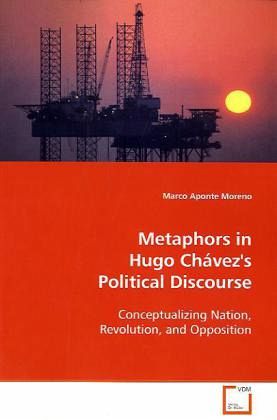
Metaphors in Hugo Chávez's Political Discourse
Conceptualizing Nation, Revolution, and Opposition
Versandkostenfrei!
Versandfertig in 6-10 Tagen
45,99 €
inkl. MwSt.

PAYBACK Punkte
23 °P sammeln!

This book provides the first comprehensive analysisof metaphors used by Hugo Chávez in his efforts to construct andlegitimize his Bolivarian Revolution. It focuses on metaphors drawn from three of his most frequent target domains:the nation, his revolution, and the opposition. The author arguesthat behind an official discourse of inclusion, Chávez's choice of metaphors contributes to the construction of apolarizing discourse of exclusion in which his political opponents arerepresented as enemies of the nation. Chávez constructs this polarizing discourse of exclusion by combiningmetaphors th...
This book provides the first comprehensive analysis
of metaphors
used by Hugo Chávez in his efforts to construct and
legitimize his
Bolivarian Revolution. It focuses on metaphors
drawn from three of his most frequent target domains:
the nation,
his revolution, and the opposition. The author argues
that behind an
official discourse of inclusion, Chávez's choice of
metaphors contributes to the construction of a
polarizing discourse
of exclusion in which his political opponents are
represented as
enemies of the nation. Chávez constructs this
polarizing discourse of exclusion by combining
metaphors that
conceptualize: (a) the nation as a person who has
been resurrected
by his government, as a person ready to fight for his
revolution, or as Chávez himself; (b) the revolution
as war; and (c)
members of the opposition as war combatants or
criminals. At the
same time, by making explicit references in his
discourse about the revolution as the continuation of
Simón Bolívar's
wars of independence, Chávez contributes to represent
opponents
as enemies of the nation, given that in the
Venezuelan collective imaginary Bolívar is the symbol
of the nation's
emancipation.
of metaphors
used by Hugo Chávez in his efforts to construct and
legitimize his
Bolivarian Revolution. It focuses on metaphors
drawn from three of his most frequent target domains:
the nation,
his revolution, and the opposition. The author argues
that behind an
official discourse of inclusion, Chávez's choice of
metaphors contributes to the construction of a
polarizing discourse
of exclusion in which his political opponents are
represented as
enemies of the nation. Chávez constructs this
polarizing discourse of exclusion by combining
metaphors that
conceptualize: (a) the nation as a person who has
been resurrected
by his government, as a person ready to fight for his
revolution, or as Chávez himself; (b) the revolution
as war; and (c)
members of the opposition as war combatants or
criminals. At the
same time, by making explicit references in his
discourse about the revolution as the continuation of
Simón Bolívar's
wars of independence, Chávez contributes to represent
opponents
as enemies of the nation, given that in the
Venezuelan collective imaginary Bolívar is the symbol
of the nation's
emancipation.
Andere Kunden interessierten sich für



![Cover Corrélats acoustiques de [voix]](https://bilder.buecher.de/produkte/63/63384/63384176n.jpg "Corrélats acoustiques de [voix]")

![Cover Akoestische correlaten van [stem]](https://bilder.buecher.de/produkte/63/63384/63384171n.jpg "Akoestische correlaten van [stem]")