
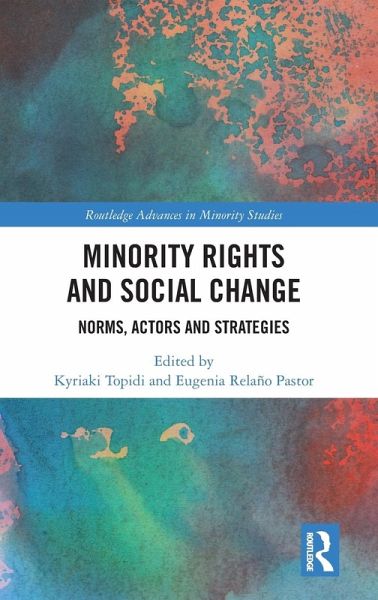
Minority Rights and Social Change
Norms, Actors and Strategies
Herausgegeben: Topidi, Kyriaki; Relaño Pastor, Eugenia
Versandkostenfrei!
Versandfertig in 6-10 Tagen
141,99 €
inkl. MwSt.
Weitere Ausgaben:

PAYBACK Punkte
71 °P sammeln!

Minority movements tirelessly continue to engage in the process of social change, trying to promote and enforce minority protection norms and to have their world views, cultural practices, and norms recognized by the state. Through an examination of selected cases, this book problematizes how collective identities are not structurally guaranteed but rather constructed in dialectically interrelated positions and identity layers. The authors show the kind of impact that these processes can, or fail to, have on minority norms, actors, and strategies.Going beyond abstract normative principles, thi...
Minority movements tirelessly continue to engage in the process of social change, trying to promote and enforce minority protection norms and to have their world views, cultural practices, and norms recognized by the state. Through an examination of selected cases, this book problematizes how collective identities are not structurally guaranteed but rather constructed in dialectically interrelated positions and identity layers. The authors show the kind of impact that these processes can, or fail to, have on minority norms, actors, and strategies.
Going beyond abstract normative principles, this collection reflects both Global North as well as Global South perspectives and examines through a variety of angles the role that race and ethnicity, culture, or religion play within social mobilization towards social change. The volume offers global insight on actor and strategy attempts to foster social change through the instrumental use and interpretation of minority rightsas norms. This book will be of interest to those researching minority rights broadly understood within the disciplines of law, anthropology, sociology, and political science.
Going beyond abstract normative principles, this collection reflects both Global North as well as Global South perspectives and examines through a variety of angles the role that race and ethnicity, culture, or religion play within social mobilization towards social change. The volume offers global insight on actor and strategy attempts to foster social change through the instrumental use and interpretation of minority rightsas norms. This book will be of interest to those researching minority rights broadly understood within the disciplines of law, anthropology, sociology, and political science.
Andere Kunden interessierten sich für