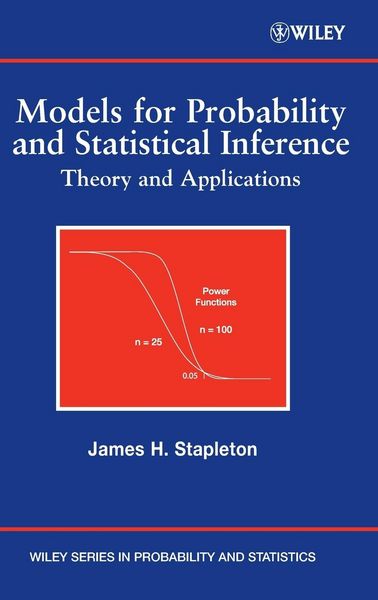
Models for Probability Theory and Applications
207,99 €
inkl. gesetzl. MwSt.,
Beschreibung
Produktdetails
Einband
Gebundene Ausgabe
Erscheinungsdatum
01.12.2007
Abbildungen
Drawings: 10 B&W, 0 Color; Graphs: 94 B&W, 0 Color
Verlag
John Wiley & Sons IncSeitenzahl
468
Maße (L/B/H)
24/16,1/2,9 cm
Gewicht
862 g
Auflage
1. Auflage
Sprache
Englisch
ISBN
978-0-470-07372-8
Models for Probability and Statistical Inference was written over a five-year period and serves as a comprehensive treatment of the fundamentals of probability and statistical inference. With detailed theoretical coverage found throughout the book, readers acquire the fundamentals needed to advance to more specialized topics, such as sampling, linear models, design of experiments, statistical computing, survival analysis, and bootstrapping.
Ideal as a textbook for a two-semester sequence on probability and statistical inference, early chapters provide coverage on probability and include discussions of: discrete models and random variables; discrete distributions including binomial, hypergeometric, geometric, and Poisson; continuous, normal, gamma, and conditional distributions; and limit theory. Since limit theory is usually the most difficult topic for readers to master, the author thoroughly discusses modes of convergence of sequences of random variables, with special attention to convergence in distribution. The second half of the book addresses statistical inference, beginning with a discussion on point estimation and followed by coverage of consistency and confidence intervals. Further areas of exploration include: distributions defined in terms of the multivariate normal, chi-square, t, and F (central and non-central); the one- and two-sample Wilcoxon test, together with methods of estimation based on both; linear models with a linear space-projection approach; and logistic regression.
Each section contains a set of problems ranging in difficulty from simple to more complex, and selected answers as well as proofs to almost all statements are provided. An abundant amount of figures in addition to helpful simulations and graphs produced by the statistical package S-Plus(r) are included to help build the intuition of readers.
Noch keine Bewertungen vorhanden
Verfassen Sie die erste Bewertung zu diesem Artikel
Helfen Sie anderen Kundinnen und Kunden durch Ihre Meinung.
Kurze Frage zu unserer Seite
Vielen Dank für dein Feedback
Wir nutzen dein Feedback, um unsere Produktseiten zu verbessern. Bitte habe Verständnis, dass wir dir keine Rückmeldung geben können. Falls du Kontakt mit uns aufnehmen möchtest, kannst du dich aber gerne an unseren Kund*innenservice wenden.
zum Kundenservice