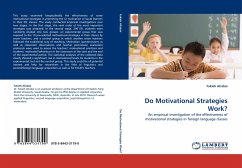
Motivational Teaching Strategies
How important are they and how frequently are they used?
Versandkostenfrei!
Versandfertig in 6-10 Tagen
32,99 €
inkl. MwSt.

PAYBACK Punkte
16 °P sammeln!

For over two decades, scholars in the field of secondlanguage teaching have proposed extensive lists ofstrategies to motivate language learners. However,the number of studies investigating the actual use ofthose strategies in L2 classrooms is meager. Thisbook examines the importance and frequency of 43motivational strategies divided into 16 conceptualdomains. Twenty-three teachers and 213 of an EFLschool participated in the investigation.Quantitative and qualitative data were drawn fromquestionnaires, interviews, and classroomobservations. The results suggest that from the 16conceptual domains...
For over two decades, scholars in the field of second
language teaching have proposed extensive lists of
strategies to motivate language learners. However,
the number of studies investigating the actual use of
those strategies in L2 classrooms is meager. This
book examines the importance and frequency of 43
motivational strategies divided into 16 conceptual
domains. Twenty-three teachers and 213 of an EFL
school participated in the investigation.
Quantitative and qualitative data were drawn from
questionnaires, interviews, and classroom
observations. The results suggest that from the 16
conceptual domains of motivational strategies, three
are potentially motivating. Results also reveal that
some strategies regarded as important have been
underutilized in the classroom. The analysis and
findings may help language instructors, researchers
in the field of linguistics and pedagogues increase
their awareness of a more motivating learning.
language teaching have proposed extensive lists of
strategies to motivate language learners. However,
the number of studies investigating the actual use of
those strategies in L2 classrooms is meager. This
book examines the importance and frequency of 43
motivational strategies divided into 16 conceptual
domains. Twenty-three teachers and 213 of an EFL
school participated in the investigation.
Quantitative and qualitative data were drawn from
questionnaires, interviews, and classroom
observations. The results suggest that from the 16
conceptual domains of motivational strategies, three
are potentially motivating. Results also reveal that
some strategies regarded as important have been
underutilized in the classroom. The analysis and
findings may help language instructors, researchers
in the field of linguistics and pedagogues increase
their awareness of a more motivating learning.
Andere Kunden interessierten sich für