
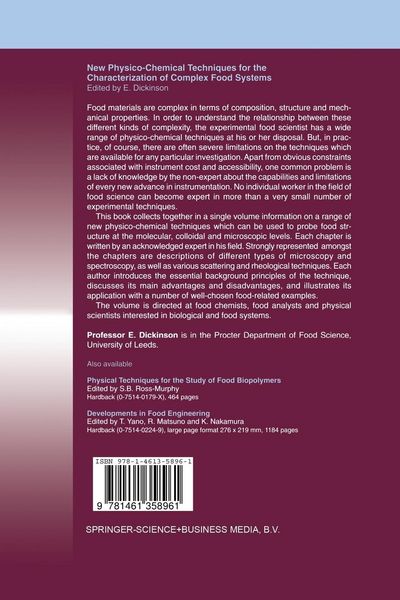
• Produktbild: New Physico-Chemical Techniques for the Characterization of Complex Food Systems
  • Produktbild: New Physico-Chemical Techniques for the Characterization of Complex Food Systems

New Physico-Chemical Techniques for the Characterization of Complex Food Systems

146,99 €

inkl. gesetzl. MwSt., Versandkostenfrei


Beschreibung

Produktdetails

Einband

Taschenbuch

Erscheinungsdatum

18.09.2012

Abbildungen

XII, 356 p.

Verlag

Springer Us

Seitenzahl

356

Maße (L/B/H)

23,5/15,5/2,1 cm

Gewicht

575 g

Auflage

Softcover reprint of the original 1st ed. 1995

Sprache

Englisch

ISBN

978-1-4613-5896-1

Beschreibung

Produktdetails

Einband

Taschenbuch

Erscheinungsdatum

18.09.2012

Abbildungen

XII, 356 p.

Verlag

Springer Us

Seitenzahl

356

Maße (L/B/H)

23,5/15,5/2,1 cm

Gewicht

575 g

Auflage

Softcover reprint of the original 1st ed. 1995

Sprache

Englisch

ISBN

978-1-4613-5896-1

Herstelleradresse

Springer-Verlag GmbH
Tiergartenstr. 17
69121 Heidelberg
DE

Email: GPSR Kontakt

Noch keine Bewertungen vorhanden

Verfassen Sie die erste Bewertung zu diesem Artikel

Helfen Sie anderen Kundinnen und Kunden durch Ihre Meinung.

Kundinnen und Kunden meinen

Bewertungen (0)

  • Produktbild: New Physico-Chemical Techniques for the Characterization of Complex Food Systems
  • Produktbild: New Physico-Chemical Techniques for the Characterization of Complex Food Systems
  • 1. Advances in Electron Microscopy.- 1.1 Introduction.- 1.2 General techniques.- 1.3 Microstructure and rheology of ovalbumin gels: example of an integrated study.- References.- 2. Imaging Food Systems by Confocal Laser Scanning Microscopy.- 2.1 Introduction.- 2.2 Principles of operation.- 2.3 Fluorescent dyes — practical aspects.- 2.4 Applications to food systems.- 2.5 Concluding remarks.- References.- 3. Scanning Probe Microscopy of Food-Related Systems.- 3.1 General introduction.- 3.2 Introduction to scanning probe microscopy techniques.- 3.3 Carbohydrates.- 3.4 Chromosomes, DNA and bases.- 3.5 Proteins.- 3.6 Cells.- 3.7 Conclusions and future prospects.- References.- 4. Electron Spin Resonance Spectroscopy for Detection of Irradiated Food.- 4.1 Introduction.- 4.2 Uses of irradiation in the food industry.- 4.3 Development of detection methods.- 4.4 Principles of electron spin resonance.- 4.5 Factors affecting spectral derivation.- 4.6 Application of ESR spectroscopy to detection of irradiated foods.- 4.7 Packaging materials.- 4.8 Multilaboratory intercomparisons.- 4.9 The future of ESR detection.- References.- 5. Ultracentrifugation of Food Biopolymers.- 5.1 Introduction and historical comment.- 5.2 Types of analytical ultracentrifuge measurement.- 5.3 Instrumentation/optical systems.- 5.4 Sedimentation velocity: shape analysis and homogeneity.- 5.5 Sedimentation equilibrium: molecular weight distribution analysis.- 5.6 Analytical density gradient sedimentation equilibrium.- References.- 6. Rheology of Biopolymer Solutions and Gels.- 6.1 Introduction.- 6.2 Biopolymer size and shape.- 6.3 Concentration regimes.- 6.4 Oscillatory measurements: mechanical spectroscopy.- 6.5 Time-temperature superposition.- Acknowledgement.- References.- 7. Fracture Mechanics of SolidFoods.- 7.1 Introduction.- 7.2 Fracture mechanics.- 7.3 Methods to evaluate fracture properties.- Acknowledgement.- References.- 8. Recent Developments in Infrared Spectroscopy and Microscopy.- 8.1 Introduction.- 8.2 Theory.- 8.3 Applications.- 8.4 Conclusions.- Acknowledgements.- References.- 9. Ultrasound Studies of Shelf-Life and Crystallization.- 9.1 Introduction.- 9.2 Theoretical background.- 9.3 Crystallization in emulsions.- 9.4 Creaming in emulsions.- 9.5 Conclusions.- References.- 10. Dynamic Surface Tension and Dilational Interfacial Properties.- 10.1 Introduction.- 10.2 Overflowing cylinder technique.- 10.3 Free falling film technique.- 10.4 Ring trough technique.- 10.5 Caterpillar trough technique.- 10.6 Mannheimer trough technique.- References.- 11. Light Scattering Studies of Colloid Stability and Gelation.- 11.1 Introduction.- 11.2 Light scattering background.- 11.3 Dynamic light scattering from concentrated opaque suspensions.- 11.4 Dynamic light scattering from gelling systems.- Acknowledgement.- References.- 12. Small-Angle Neutron Scattering and Neutron Reflection.- 12.1 Introduction.- 12.2 Principles of scattering methods.- 12.3 Why use neutrons?.- 12.4 Small-angle neutron scattering (SANS).- 12.5 Neutron reflectometry.- 12.6 Outlook.- Acknowledgements.- References.- 13. High Resolution Nuclear Magnetic Resonance Spectroscopy of Solid and Semi-Solid Food Components.- 13.1 General considerations.- 13.2 Chemical information: molecular conformation and order.- 13.3 Physical information: mobility-resolved spectroscopy.- 13.4 Agarose, ?-carrageenan and ?-carrageenan.- 13.5 Summary and future challenges.- References.- 14. Magnetic Resonance Imaging in Food Science.- 14.1 Introduction.- 14.2 Principles of magnetic resonance imaging.- 14.3 Overview ofapplications.- 14.4 Quantitative imaging protocols.- 14.5 Application of T2-weighted radial imaging protocol to rehydration of extruded pasta.- 14.6 Theoretical modelling of moisture profiles.- 14.7 Conclusions.- References.