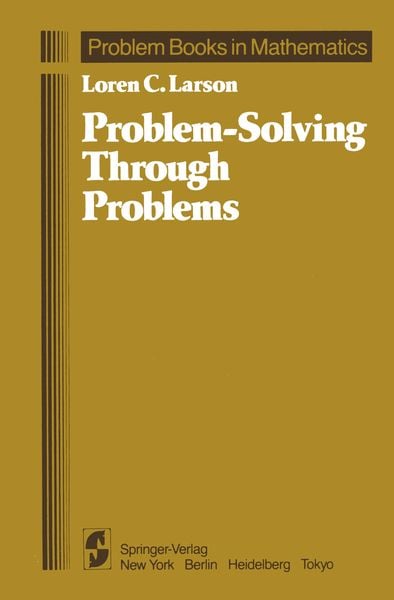

• Produktbild: Problem-Solving Through Problems
  • Produktbild: Problem-Solving Through Problems

Problem-Solving Through Problems

87,99 €

inkl. gesetzl. MwSt., Versandkostenfrei


Beschreibung

Produktdetails

Einband

Taschenbuch

Erscheinungsdatum

17.07.1985

Abbildungen

XI, 352 p. 11 illus.

Verlag

Springer Us

Seitenzahl

352

Maße (L/B/H)

23,3/15,5/2 cm

Gewicht

530 g

Auflage

1983

Sprache

Englisch

ISBN

978-0-387-96171-2

Beschreibung

Rezension

From the reviews:


"This is a very welcome addition. The main message of the book is that the only way to learn to solve problems is to solve problems! I found this book very helpful. I am quite sure the book will be in constant use and I have no hesitation in recommending it."
(The Mathematical Gazette)

Produktdetails

Einband

Taschenbuch

Erscheinungsdatum

17.07.1985

Abbildungen

XI, 352 p. 11 illus.

Verlag

Springer Us

Seitenzahl

352

Maße (L/B/H)

23,3/15,5/2 cm

Gewicht

530 g

Auflage

1983

Sprache

Englisch

ISBN

978-0-387-96171-2

Herstelleradresse

Springer-Verlag KG
Sachsenplatz 4-6
1201 Wien
AT

Email: ProductSafety@springernature.com

Noch keine Bewertungen vorhanden

Verfassen Sie die erste Bewertung zu diesem Artikel

Helfen Sie anderen Kundinnen und Kunden durch Ihre Meinung.

Kundinnen und Kunden meinen

Bewertungen (0)

  • Produktbild: Problem-Solving Through Problems
  • Produktbild: Problem-Solving Through Problems
  • 1. Heuristics.- 1.1. Search for a Pattern.- 1.2. Draw a Figure.- 1.3. Formulate an Equivalent Problem.- 1.4. Modify the Problem.- 1.5. Choose Effective Notation.- 1.6. Exploit Symmetry.- 1.7. Divide into Cases.- 1.8. Work Backward.- 1.9. Argue by Contradiction.- 1.10. Pursue Parity.- 1.11. Consider Extreme Cases.- 1.12. Generalize.- 2. Two Important Principles: Induction and Pigeonhole.- 2.1. Induction: Build on P(k).- 2.2. Induction: Set Up P(k + 1).- 2.3. Strong Induction.- 2.4. Induction and Generalization.- 2.5. Recursion.- 2.6. Pigeonhole Principle.- 3. Arithmetic.- 3.1. Greatest Common Divisor.- 3.2. Modular Arithmetic.- 3.3. Unique Factorization.- 3.4. Positional Notation.- 3.5. Arithmetic of Complex Numbers.- 4. Algebra.- 4.1. Algebraic Identities.- 4.2. Unique Factorization of Polynomials.- 4.3. The Identity Theorem.- 4.4. Abstract Algebra.- 5. Summation of Series.- 5.1. Binomial Coefficients.- 5.2. Geometric Series.- 5.3. Telescoping Series.- 5.4. Power Series.- 6. Intermediate Real Analysis.- 6.1. Continuous Functions.- 6.2. The Intermediate-Value Theorem.- 6.3. The Derivative.- 6.4. The Extreme-Value Theorem.- 6.5. Rolle’s Theorem.- 6.6. The Mean Value Theorem.- 6.7. L’Hôpital’s Rule.- 6.8. The Integral.- 6.9. The Fundamental Theorem.- 7. Inequalities.- 7.1. Basic Inequality Properties.- 7.2. Arithmetic-Mean-Geometric-Mean Inequality.- 7.3. Cauchy-Schwarz Inequality.- 7.4. Functional Considerations.- 7.5. Inequalities by Series.- 7.6. The Squeeze Principle.- 8. Geometry.- 8.1. Classical Plane Geometry.- 8.2. Analytic Geometry.- 8.3. Vector Geometry.- 8.4. Complex Numbers in Geometry.- Glossary of Symbols and Definitions.- Sources.