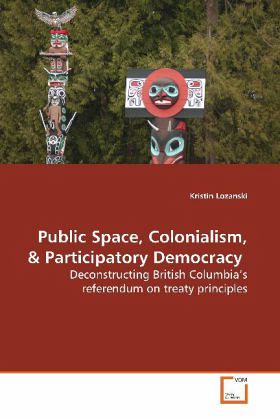
Public Space, Colonialism,
Deconstructing British Columbia s referendum on treaty principles
Versandkostenfrei!
Versandfertig in 6-10 Tagen
32,99 €
inkl. MwSt.

PAYBACK Punkte
16 °P sammeln!

In the fall of 2001, British Columbia s newly-electedLiberal government organized a series of publichearings to collect citizen input on theprinciples that should guide treaty negotiation. These hearings were established to renew thestalled treaty process in B.C., which had failed toyield any modern treaties in the province. However, rather than providing space for meaningfulengagement with the issue of Indigenous land claimsin B.C., the public hearings reiterated colonialexclusions. In this discourse analysis, the processof public democracy is deconstructed toemphasize the multiple ways throu...
In the fall of 2001, British Columbia s newly-elected
Liberal government organized a series of public
hearings to collect citizen input on the
principles that should guide treaty negotiation.
These hearings were established to renew the
stalled treaty process in B.C., which had failed to
yield any modern treaties in the province.
However, rather than providing space for meaningful
engagement with the issue of Indigenous land claims
in B.C., the public hearings reiterated colonial
exclusions. In this discourse analysis, the process
of public democracy is deconstructed to
emphasize the multiple ways through which the
government and numerous presenters reiterated the
colonial status quo. The reiteration of colonial
principles was enabled through common-sense appeals
to liberal democratic principles, such as freedom,
equality, individualism, and a reduced role for the
state. This critical analysis will be of interest to
scholars and students working in the areas of
Canadian Studies, Indigenous Studies, Political
Science, and Sociology, along with anyone seeking a
comprehensive understanding of persisting colonial
practices in contemporary Canada.
Liberal government organized a series of public
hearings to collect citizen input on the
principles that should guide treaty negotiation.
These hearings were established to renew the
stalled treaty process in B.C., which had failed to
yield any modern treaties in the province.
However, rather than providing space for meaningful
engagement with the issue of Indigenous land claims
in B.C., the public hearings reiterated colonial
exclusions. In this discourse analysis, the process
of public democracy is deconstructed to
emphasize the multiple ways through which the
government and numerous presenters reiterated the
colonial status quo. The reiteration of colonial
principles was enabled through common-sense appeals
to liberal democratic principles, such as freedom,
equality, individualism, and a reduced role for the
state. This critical analysis will be of interest to
scholars and students working in the areas of
Canadian Studies, Indigenous Studies, Political
Science, and Sociology, along with anyone seeking a
comprehensive understanding of persisting colonial
practices in contemporary Canada.