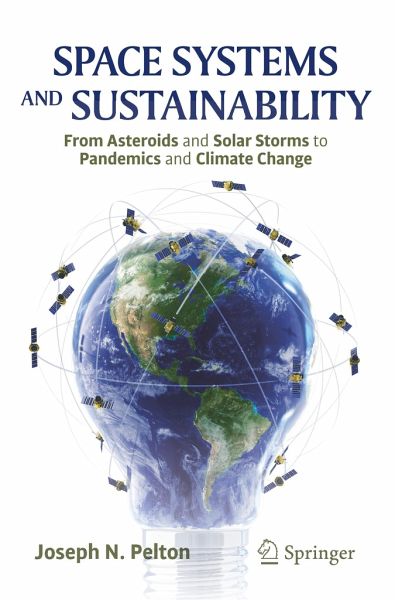
Space Systems and Sustainability
From Asteroids and Solar Storms to Pandemics and Climate Change

PAYBACK Punkte
14 °P sammeln!

In his latest book, space scientist, futurist, and educator Joseph N. Pelton explores adozen ways that Planet Earth is at "existential" risk, along with the many ways thatspace systems, data analytics, and advanced networking systems can help us copewith these global challenges.The chapters examine in a straightforward way how satellite systems and technol-ogy can drastically transform fields such as pandemic tracking and global medicalresponses, cosmic hazard monitoring, nuclear energy and waste disposal, water andland pollution, tele-education/telemedicine, and military conflict. Such exampl...
In his latest book, space scientist, futurist, and educator Joseph N. Pelton explores a
dozen ways that Planet Earth is at "existential" risk, along with the many ways that
space systems, data analytics, and advanced networking systems can help us cope
with these global challenges.
The chapters examine in a straightforward way how satellite systems and technol-
ogy can drastically transform fields such as pandemic tracking and global medical
responses, cosmic hazard monitoring, nuclear energy and waste disposal, water and
land pollution, tele-education/telemedicine, and military conflict. Such examples
show how orbiting smart systems will play an ever more vital role in our vulnerable
modern world, allowing us to monitor, track, and respond to mounting problems of
the 21st century.
Dr. Pelton takes a broad view, probing the social, economic, and regulatory factors
that are crucial to creating a more sustainable "Spaceship Earth." This book is a call
to action, promoting more organized international collaboration and investment in
space technologies that can enable global change.
dozen ways that Planet Earth is at "existential" risk, along with the many ways that
space systems, data analytics, and advanced networking systems can help us cope
with these global challenges.
The chapters examine in a straightforward way how satellite systems and technol-
ogy can drastically transform fields such as pandemic tracking and global medical
responses, cosmic hazard monitoring, nuclear energy and waste disposal, water and
land pollution, tele-education/telemedicine, and military conflict. Such examples
show how orbiting smart systems will play an ever more vital role in our vulnerable
modern world, allowing us to monitor, track, and respond to mounting problems of
the 21st century.
Dr. Pelton takes a broad view, probing the social, economic, and regulatory factors
that are crucial to creating a more sustainable "Spaceship Earth." This book is a call
to action, promoting more organized international collaboration and investment in
space technologies that can enable global change.