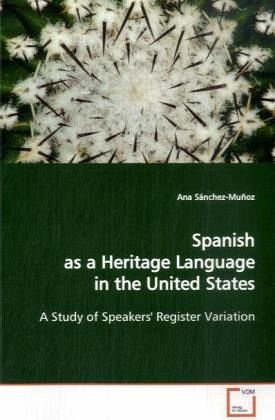
Spanish as a Heritage Language in the United States
A Study of Speakers' Register Variation
Versandkostenfrei!
Versandfertig in 6-10 Tagen
39,99 €
inkl. MwSt.

PAYBACK Punkte
20 °P sammeln!

One of the fundamental principles of sociolinguisticsis no single person speaks in the same way all thetime. This book explores variation across registersin Spanish as a heritage language. Additionally, itexamines second language learners since Spanish isalso their non-dominant language.This work analyzes several linguistic featuresincluding discourse particles, contractions, andvarious lexical choices. The results indicate thatboth heritage and second language speakers showlinguistic variation in their Spanish acrossregisters. The results also reveal some quantitativeas well as qualitative di...
One of the fundamental principles of sociolinguistics
is no single person speaks in the same way all the
time. This book explores variation across registers
in Spanish as a heritage language. Additionally, it
examines second language learners since Spanish is
also their non-dominant language.
This work analyzes several linguistic features
including discourse particles, contractions, and
various lexical choices. The results indicate that
both heritage and second language speakers show
linguistic variation in their Spanish across
registers. The results also reveal some quantitative
as well as qualitative differences between the two
groups of speakers, which have important pedagogical
implications for the teaching and learning of
heritage languages. This book contributes to further
our understanding of bilingualism by providing
evidence of variation in speakers non-dominant
language. This is an important finding since it shows
that even when the use of the language is largely
limited to a particular domain (home/family
interactions for heritage speakers and classroom
interactions for second language learners), we can
still find register variation.
is no single person speaks in the same way all the
time. This book explores variation across registers
in Spanish as a heritage language. Additionally, it
examines second language learners since Spanish is
also their non-dominant language.
This work analyzes several linguistic features
including discourse particles, contractions, and
various lexical choices. The results indicate that
both heritage and second language speakers show
linguistic variation in their Spanish across
registers. The results also reveal some quantitative
as well as qualitative differences between the two
groups of speakers, which have important pedagogical
implications for the teaching and learning of
heritage languages. This book contributes to further
our understanding of bilingualism by providing
evidence of variation in speakers non-dominant
language. This is an important finding since it shows
that even when the use of the language is largely
limited to a particular domain (home/family
interactions for heritage speakers and classroom
interactions for second language learners), we can
still find register variation.
Andere Kunden interessierten sich für