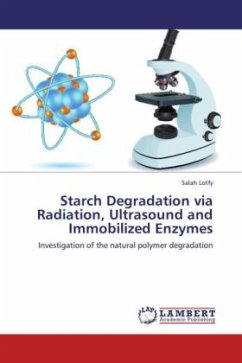
Starch Degradation via Radiation, Ultrasound and Immobilized Enzymes
Investigation of the natural polymer degradation
Versandkostenfrei!
Versandfertig in 6-10 Tagen
52,99 €
inkl. MwSt.

PAYBACK Punkte
26 °P sammeln!

Ionizing radiation has been found to be widely applicable in modifying the structure and properties of polymers. Using of ionizing radiation for regulation of molecular weight of natural polymer and preparation of polymeric biomaterials, for industrial biotechnology are examples of the application of atomic energy for the benefit of humanity. Quantitative data on both of the ionizing radiation and ultrasound-induced degradation of starch were provided. Mechanochemical and radical reactions were contributed to chain scission of starch as natural polymer in solid, suspension and aqueous solution...
Ionizing radiation has been found to be widely applicable in modifying the structure and properties of polymers. Using of ionizing radiation for regulation of molecular weight of natural polymer and preparation of polymeric biomaterials, for industrial biotechnology are examples of the application of atomic energy for the benefit of humanity. Quantitative data on both of the ionizing radiation and ultrasound-induced degradation of starch were provided. Mechanochemical and radical reactions were contributed to chain scission of starch as natural polymer in solid, suspension and aqueous solution at an ultrasound frequency. Another goal of this study is preparation and characterization of graft copolymers synthesized via radiation of acrylic and acrylamide monomers onto polypropylene fibers. Essential conversion of starch into glucose is generally carried out by hydrolyzing with mineral acids or with alpha-amylase to limit dextrin, followed by saccharification using glucoamylase. Glucoamylase was successfully immobilized on prepared grafted copolymer as enzyme-carrier, found to be more efficient when combined with radiation degradation.
Andere Kunden interessierten sich für






![Cover Iron (II) and Ruthenium (II) Sulfur complexes modelling [MS] enzymes](https://bilder.buecher.de/produkte/35/35517/35517145n.jpg "Iron (II) and Ruthenium (II) Sulfur complexes modelling [MS] enzymes")