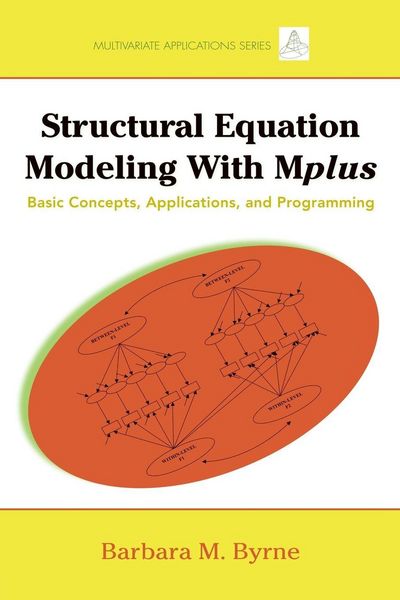
Structural Equation Modeling with Mplus Basic Concepts, Applications, and Programming
-
- Hardcover
- Taschenbuch ausgewählt
- eBook
-
Sprache:Englisch
92,99 €
inkl. gesetzl. MwSt.,
Beschreibung
Produktdetails
Einband
Taschenbuch
Erscheinungsdatum
21.07.2011
Verlag
Taylor & FrancisSeitenzahl
432
Maße (L/B/H)
22,9/15,2/2,3 cm
Gewicht
622 g
Sprache
Englisch
ISBN
978-1-84872-839-4
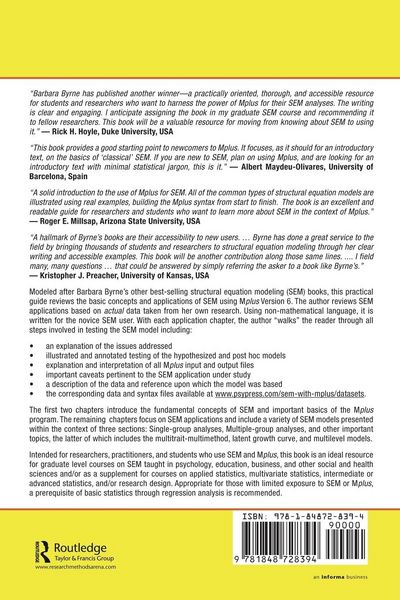
Modeled after Barbara Byrne's other best-selling structural equation modeling (SEM) books, this practical guide reviews the basic concepts and applications of SEM using Mplus Versions 5 & 6. The author reviews SEM applications based on actual data taken from her own research. Using non-mathematical language, it is written for the novice SEM user. With each application chapter, the author "walks" the reader through all steps involved in testing the SEM model including:
- an explanation of the issues addressed
- illustrated and annotated testing of the hypothesized and post hoc models
- explanation and interpretation of all Mplus input and output files
- important caveats pertinent to the SEM application under study
- a description of the data and reference upon which the model was based
- the corresponding data and syntax files available under "Supplementary Material" below
The first two chapters introduce the fundamental concepts of SEM and important basics of the Mplus program. The remaining chapters focus on SEM applications and include a variety of SEM models presented within the context of three sections: Single-group analyses, Multiple-group analyses, and other important topics, the latter of which includes the multitrait-multimethod, latent growth curve, and multilevel models.
Intended for researchers, practitioners, and students who use SEM and Mplus, this book is an ideal resource for graduate level courses on SEM taught in psychology, education, business, and other social and health sciences and/or as a supplement for courses on applied statistics, multivariate statistics, intermediate or advanced statistics, and/or research design. Appropriate for those with limited exposure to SEM or Mplus, a prerequisite of basic statistics through regression analysis is recommended.
Noch keine Bewertungen vorhanden
Verfassen Sie die erste Bewertung zu diesem Artikel
Helfen Sie anderen Kundinnen und Kunden durch Ihre Meinung.
Kurze Frage zu unserer Seite
Vielen Dank für dein Feedback
Wir nutzen dein Feedback, um unsere Produktseiten zu verbessern. Bitte habe Verständnis, dass wir dir keine Rückmeldung geben können. Falls du Kontakt mit uns aufnehmen möchtest, kannst du dich aber gerne an unseren Kund*innenservice wenden.
zum Kundenservice