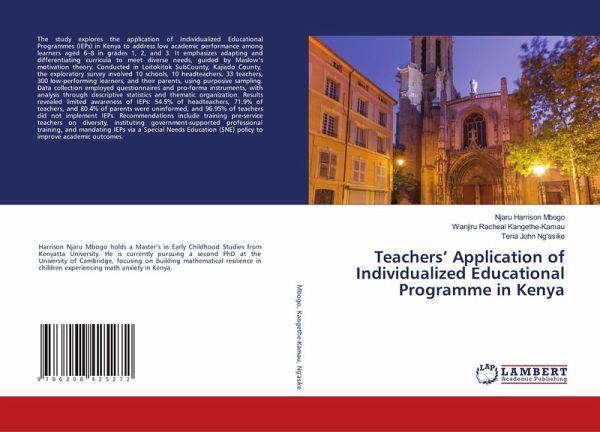
Teachers' Application of Individualized Educational Programme in Kenya
Versandkostenfrei!
Versandfertig in 6-10 Tagen
45,99 €
inkl. MwSt.

PAYBACK Punkte
23 °P sammeln!

The study explores the application of Individualized Educational Programmes (IEPs) in Kenya to address low academic performance among learners aged 6-8 in grades 1, 2, and 3. It emphasizes adapting and differentiating curricula to meet diverse needs, guided by Maslow's motivation theory. Conducted in Loitokitok SubCounty, Kajiado County, the exploratory survey involved 10 schools, 10 headteachers, 33 teachers, 300 low-performing learners, and their parents, using purposive sampling. Data collection employed questionnaires and pro-forma instruments, with analysis through descriptive statistics ...
The study explores the application of Individualized Educational Programmes (IEPs) in Kenya to address low academic performance among learners aged 6-8 in grades 1, 2, and 3. It emphasizes adapting and differentiating curricula to meet diverse needs, guided by Maslow's motivation theory. Conducted in Loitokitok SubCounty, Kajiado County, the exploratory survey involved 10 schools, 10 headteachers, 33 teachers, 300 low-performing learners, and their parents, using purposive sampling. Data collection employed questionnaires and pro-forma instruments, with analysis through descriptive statistics and thematic organization. Results revealed limited awareness of IEPs: 54.5% of headteachers, 71.9% of teachers, and 80.4% of parents were uninformed, and 96.95% of teachers did not implement IEPs. Recommendations include training pre-service teachers on diversity, instituting government-supported professional training, and mandating IEPs via a Special Needs Education (SNE) policy to improveacademic outcomes.
Andere Kunden interessierten sich für