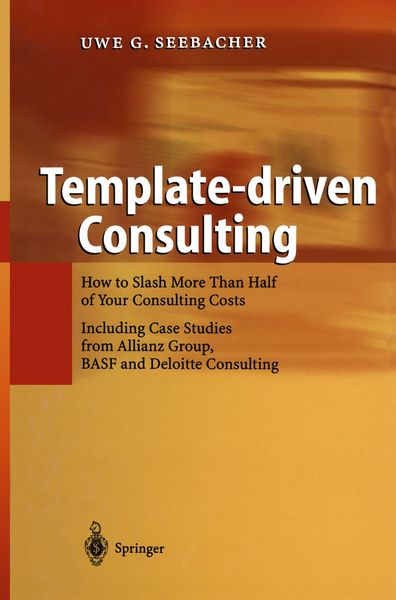
Template-driven Consulting How to Slash More Than Half of Your Consulting Costs
-
- Hardcover
- Taschenbuch ausgewählt
-
Sprache:Englisch
49,99 €
inkl. gesetzl. MwSt.,
Beschreibung
Produktdetails
Einband
Taschenbuch
Erscheinungsdatum
30.11.2010
Abbildungen
XVI, 253 p.
Verlag
Springer BerlinSeitenzahl
253
Maße (L/B/H)
23,5/15,5/1,5 cm
Gewicht
417 g
Auflage
Softcover reprint of hardcover 1st edition 2003
Sprache
Englisch
ISBN
978-3-642-07266-6
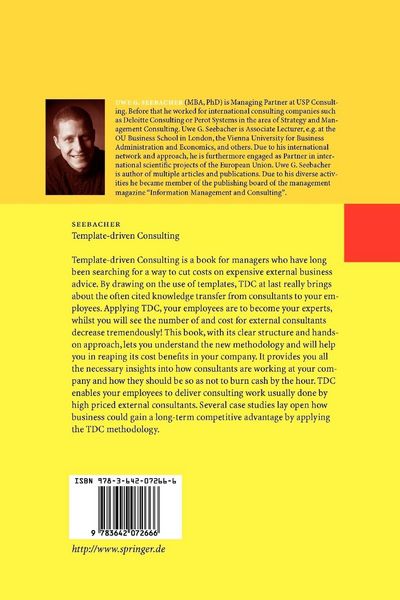
Template-driven Consulting is a book for managers who have long been searching for a way to cut costs on expensive external business advice. Every day, new stories of companies that have gone belly up or encounter severe financial troubles show up on the front pages of newspapers across the globe. Cost-cutting is again the most pressing issue in organizations - initiating massive layoffs and large-scale reductions in spending on capital goods. Template-driven Consulting (TDC) allows your company to trim down expenses at another source: external consultants. By drawing on the use of templates, TDC at last really brings about the often cited knowledge transfer from consultants to your employees. Applying TDC, your employees are to become your experts, whilst you will see the number of and cost for external consultants decrease tremendously! This book, with its clear structure and hands-on approach, lets you understand the new methodology and will help you in reaping its cost benefits in your company. It provides you all the necessary insights into how consultants are working at your company and how they should be so as not to burn cash by the hour. TDC puts you in the driver's seat and gives you a cutting-edge advantage: empowering your own employees to deliver consulting work usually done by high-priced externals. Template-driven Consulting shows you what you can expect from consultants. Besides, several case studies lay open how business could gain a long-term competitive advantage by applying the TDC methodology.
Noch keine Bewertungen vorhanden
Verfassen Sie die erste Bewertung zu diesem Artikel
Helfen Sie anderen Kundinnen und Kunden durch Ihre Meinung.
Kurze Frage zu unserer Seite
Vielen Dank für dein Feedback
Wir nutzen dein Feedback, um unsere Produktseiten zu verbessern. Bitte habe Verständnis, dass wir dir keine Rückmeldung geben können. Falls du Kontakt mit uns aufnehmen möchtest, kannst du dich aber gerne an unseren Kund*innenservice wenden.
zum Kundenservice