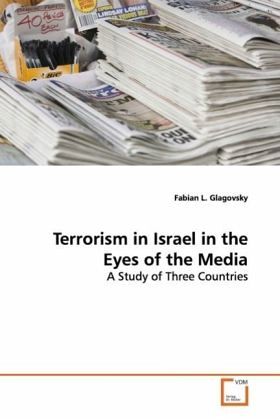
Terrorism in Israel in the Eyes of the Media
A Study of Three Countries
Versandkostenfrei!
Versandfertig in 6-10 Tagen
32,99 €
inkl. MwSt.

PAYBACK Punkte
16 °P sammeln!

Is the print Media favorable disposed towards the Israelis or the Palestinians? This bloody conflict in the Middle East has a global repercussion and the importance for the sides of its Media portrayal cannot be underestimated.After a terrorist attack, why is there such a wide gap in attributions of blame to each side between different newspapers? Why are different solutions for the conflict proposed? Do these different evaluations tell us something about each newspaper or their readership? Does it matter how each newspaper evaluates the conflict? Media and Terror in Israel attempts to answer ...
Is the print Media favorable disposed towards the
Israelis or the Palestinians? This bloody conflict
in the Middle East has a global repercussion and the
importance for the sides of its Media portrayal
cannot be underestimated.
After a terrorist attack, why is there such a wide
gap in attributions of blame to each side between
different newspapers? Why are different solutions
for the conflict proposed? Do these different
evaluations tell us something about each newspaper
or their readership? Does it matter how each
newspaper evaluates the conflict? Media and Terror
in Israel attempts to answer these questions using
an empirical approach in the field of social
sciences.
A large number of newspaper editorials from the
United States, Spain and Israel of a ten-year period
(1996-2006) are sampled and analyzed quantitatively
and qualitatively. The results allow us to determine
how the cultural base in each country, the type of
newspaper and the experiences of mass terrorism in
each country shape the way in which blame for the
violence in the Israeli-Palestinian conflict is
allocated.
Israelis or the Palestinians? This bloody conflict
in the Middle East has a global repercussion and the
importance for the sides of its Media portrayal
cannot be underestimated.
After a terrorist attack, why is there such a wide
gap in attributions of blame to each side between
different newspapers? Why are different solutions
for the conflict proposed? Do these different
evaluations tell us something about each newspaper
or their readership? Does it matter how each
newspaper evaluates the conflict? Media and Terror
in Israel attempts to answer these questions using
an empirical approach in the field of social
sciences.
A large number of newspaper editorials from the
United States, Spain and Israel of a ten-year period
(1996-2006) are sampled and analyzed quantitatively
and qualitatively. The results allow us to determine
how the cultural base in each country, the type of
newspaper and the experiences of mass terrorism in
each country shape the way in which blame for the
violence in the Israeli-Palestinian conflict is
allocated.
Andere Kunden interessierten sich für