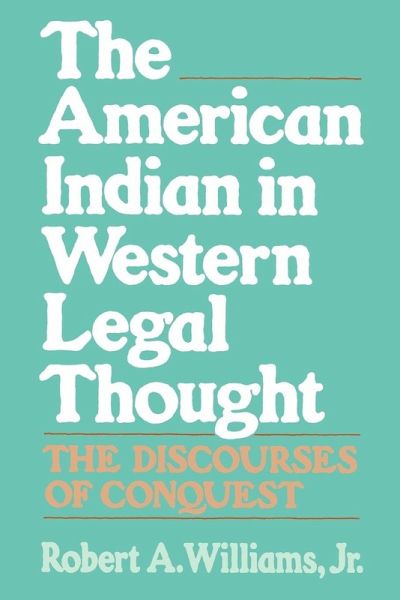
The American Indian in Western Legal Thought
The Discourses of Conquest

PAYBACK Punkte
45 °P sammeln!

In The American Indian in Western Legal Thought Robert Williams, a legal scholar and Native American of the Lumbee tribe, traces the evolution of contemporary legal thought on the rights and status of American Indians and other indiginous tribal peoples. Beginning with an analysis of the medieval Christian crusading era and its substantive contributions to the West's legal discourse of 'heathens' and 'infidels', this study explores the development of the ideas that justified the New World conquests of Spain, England and the United States. Williams shows that long-held notions of the legality of European subjugation and colonization of 'savage' and 'barbarian' societies supported the conquests in America. Today, he demonstrates, echoes of racist and Eurocentric prejudices still reverberate in the doctrines and principles of legal discourse regarding native peoples' rights in the United States and in other nations as well.
Robert Williams, a legal scholar and Native American of the Lumbee tribe, here traces the evolution of contemporary legal thought on the rights and status of the American Indian and indigenous tribal peoples. Beginning with an analysis of the Christian crusading era and its contribution to the West's legal discourses on `heathen' and `infidel' peoples' rights, Williams explores the sources and transformations of ideas that justified the New World conquests of Spain, England, and America. Long-held notions of the legality of European subjugation and colonization of `savage' and `barbarian' societies, he argues, impelled the West's conquests in America. Today, the echoes of those racist and Eurocentric prejudices still reverberate in Westen legal discourse regarding native peoples' rights. Williams argues strongly for the rejection of Western legal conceptions that reduce tribal people to culturally, politically, and morally inferior beings. He advocates the recognition of the equal sovereignty of indigenous nations to govern themselves in the world community. This work stands out as an important contribution to the growing movement for broader acceptance of indigenous peoples' rights as sovereign, self-determining entities.
Andere Kunden interessierten sich für