KI-Beratung Beta

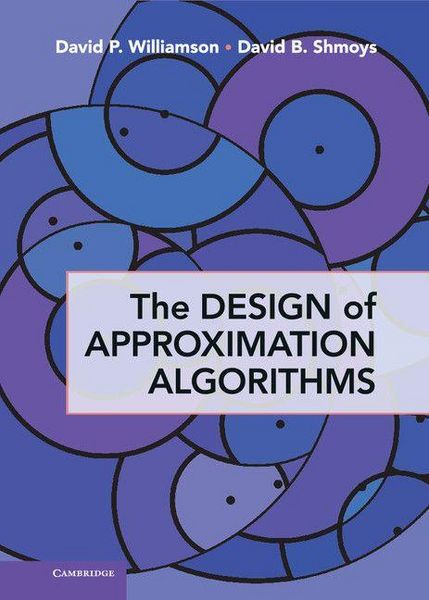
  • Produktbild: The Design of Approximation Algorithms
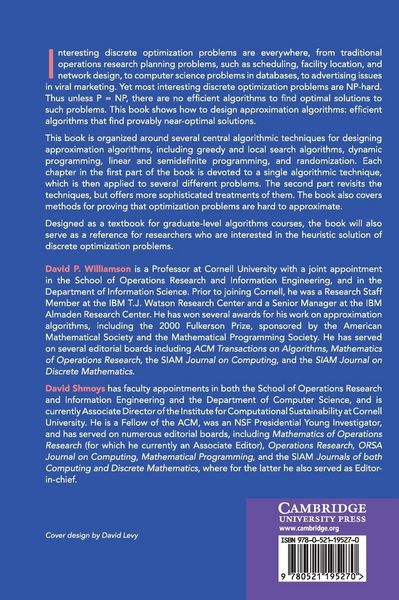
  • Produktbild: The Design of Approximation Algorithms

The Design of Approximation Algorithms

92,99 €

inkl. gesetzl. MwSt., Versandkostenfrei


Beschreibung

Produktdetails

Einband

Gebundene Ausgabe

Erscheinungsdatum

16.06.2011

Abbildungen

86 b/w illus. 121 exercises

Verlag

KNV Besorgung

Seitenzahl

518

Maße (L/B/H)

26/18,3/3,2 cm

Gewicht

1159 g

Sprache

Englisch

ISBN

978-0-521-19527-0

Beschreibung

Rezension

"This is a beautifully written book that will bring anyone who reads it to the current frontiers of research in approximation algorithms. It covers everything from the classics to the latest, most exciting results such as ARV's sparsest cut algorithm, and does so in an extraordinarily clear, rigorous and intuitive manner."
Anna Karlin, University of Washington

Produktdetails

Einband

Gebundene Ausgabe

Erscheinungsdatum

16.06.2011

Abbildungen

86 b/w illus. 121 exercises

Verlag

KNV Besorgung

Seitenzahl

518

Maße (L/B/H)

26/18,3/3,2 cm

Gewicht

1159 g

Sprache

Englisch

ISBN

978-0-521-19527-0

Herstelleradresse

Libri GmbH
Europaallee 1
36244 Bad Hersfeld
DE

Email: gpsr@libri.de

Noch keine Bewertungen vorhanden

Verfassen Sie die erste Bewertung zu diesem Artikel

Helfen Sie anderen Kundinnen und Kunden durch Ihre Meinung.

Kundinnen und Kunden meinen

Bewertungen (0)

Weitere Artikel findest du in

  • Produktbild: The Design of Approximation Algorithms
  • Produktbild: The Design of Approximation Algorithms
  • Part I. An Introduction to the Techniques: 1. An introduction to approximation algorithms; 2. Greedy algorithms and local search; 3. Rounding data and dynamic programming; 4. Deterministic rounding of linear programs; 5. Random sampling and randomized rounding of linear programs; 6. Randomized rounding of semidefinite programs; 7. The primal-dual method; 8. Cuts and metrics; Part II. Further Uses of the Techniques: 9. Further uses of greedy and local search algorithms; 10. Further uses of rounding data and dynamic programming; 11. Further uses of deterministic rounding of linear programs; 12. Further uses of random sampling and randomized rounding of linear programs; 13. Further uses of randomized rounding of semidefinite programs; 14. Further uses of the primal-dual method; 15. Further uses of cuts and metrics; 16. Techniques in proving the hardness of approximation; 17. Open problems; Appendix A. Linear programming; Appendix B. NP-completeness.