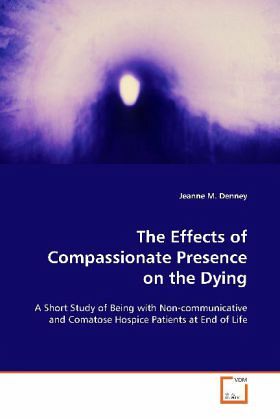
The Effects of Compassionate Presence on the Dying:
A Short Study of Being with Non- communicative and Comatose Hospice Patients at End of Life
Versandkostenfrei!
Versandfertig in 6-10 Tagen
52,99 €
inkl. MwSt.

PAYBACK Punkte
26 °P sammeln!

In the United States alone each year over 2.4 million people die. The vast majority of these deaths culminate in a non-communicative or comatose state, yet it is surprisingly uncommon for researchers to study the non-communicative dying, their needs and their responses directly. Rather, most studies focus on the experiences of dying people while they are still in communicative states or on their families. As a result, there is still much to be learned about this silent passage and the spiritual care most likely to help the dying and their families. What do they need? And how can we help?Jeanne...
In the United States alone each year over 2.4
million people die. The vast majority of these
deaths culminate in a non-communicative or comatose
state, yet it is surprisingly uncommon for
researchers to study the non-communicative dying,
their needs and their responses directly. Rather,
most studies focus on the experiences of dying
people while they are still in communicative states
or on their families. As a result, there is still
much to be learned about this silent passage and the
spiritual care most likely to help the dying and
their families. What do they need? And
how can we help?
Jeanne Denney''s pioneering work takes a bold
step in end of life study to address these
questions. Using biofeedback technology, she opens
a dialogue with the dying that yields insight on
their experiences, their needs and the experience of
caregiving generally. The results were surprising
and instructive, yielding hope for families,
powerful indications that more research of this
nature needs to be done, and direction for
this future work.
million people die. The vast majority of these
deaths culminate in a non-communicative or comatose
state, yet it is surprisingly uncommon for
researchers to study the non-communicative dying,
their needs and their responses directly. Rather,
most studies focus on the experiences of dying
people while they are still in communicative states
or on their families. As a result, there is still
much to be learned about this silent passage and the
spiritual care most likely to help the dying and
their families. What do they need? And
how can we help?
Jeanne Denney''s pioneering work takes a bold
step in end of life study to address these
questions. Using biofeedback technology, she opens
a dialogue with the dying that yields insight on
their experiences, their needs and the experience of
caregiving generally. The results were surprising
and instructive, yielding hope for families,
powerful indications that more research of this
nature needs to be done, and direction for
this future work.
Andere Kunden interessierten sich für