• Produktbild: The Medieval Heritage in Early Modern Metaphysics and Modal Theory, 1400–1700
  • Produktbild: The Medieval Heritage in Early Modern Metaphysics and Modal Theory, 1400–1700
Band 53

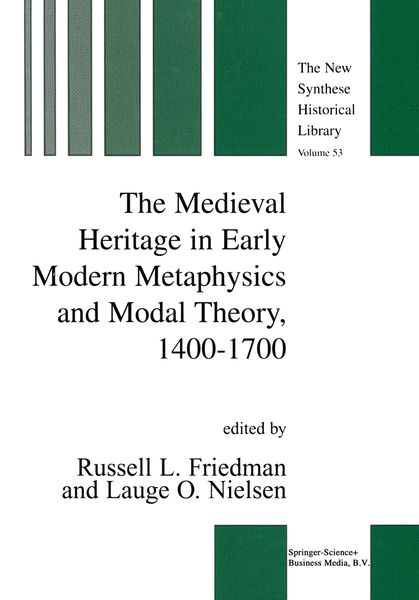
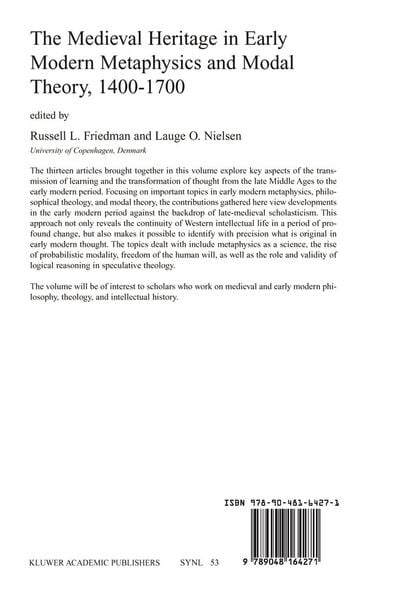
The Medieval Heritage in Early Modern Metaphysics and Modal Theory, 1400–1700

146,99 €

inkl. gesetzl. MwSt., Versandkostenfrei


Beschreibung

Produktdetails

Einband

Taschenbuch

Erscheinungsdatum

15.12.2010

Abbildungen

VI, 349 p. 1 illus.

Herausgeber

R.L. Friedman + weitere

Verlag

Springer Netherland

Seitenzahl

349

Maße (L/B/H)

24,4/17/2 cm

Gewicht

615 g

Auflage

1. Auflage

Sprache

Englisch

ISBN

978-90-481-6427-1

Beschreibung

Rezension

"(...) the book as a whole, by presenting the recent work of leading scholars in this field, provides a good starting point for further researches in the field of late medieval and early modern philosophy."


Jean-Pascal Anfray, University of Paris IV-Sorbonne in the
Journal of the History of Philosophy
43:2, April 2005

Produktdetails

Einband

Taschenbuch

Erscheinungsdatum

15.12.2010

Abbildungen

VI, 349 p. 1 illus.

Herausgeber

Verlag

Springer Netherland

Seitenzahl

349

Maße (L/B/H)

24,4/17/2 cm

Gewicht

615 g

Auflage

1. Auflage

Sprache

Englisch

ISBN

978-90-481-6427-1

Herstelleradresse

Springer-Verlag KG
Sachsenplatz 4-6
1201 Wien
AT

Email: ProductSafety@springernature.com

Noch keine Bewertungen vorhanden

Verfassen Sie die erste Bewertung zu diesem Artikel

Helfen Sie anderen Kundinnen und Kunden durch Ihre Meinung.

Kundinnen und Kunden meinen

Bewertungen (0)

  • Produktbild: The Medieval Heritage in Early Modern Metaphysics and Modal Theory, 1400–1700
  • Produktbild: The Medieval Heritage in Early Modern Metaphysics and Modal Theory, 1400–1700
  • 1. Introduction.- 2. Via Antiqua and Via Moderna in the Fifteenth Century: Doctrinal, Institutional, and Church Political Factors in the Wegestreit.- 3. Ockham and Locke on Mental Language.- 4. Metaphysics as a Discipline: From the “Transcendental Philosophy of the Ancients” to Kant’s Notion of Transcendental Philosophy.- 5. God as First Principle and Metaphysics as a Science.- 6. Gabriel Biel and Later-Medieval Trinitarian Theology.- 7. The Question of the Validity of Logic in Late Medieval Thought.- 8. Uses of Philosophy in Reformation Thought: Melanchthon, Schegk, and Crellius.- 9. Divine Foreknowledge and Human Freedom: Auriol, Pomponazzi, and Luther on “Scholastic Subtleties”.- 10. The Ontological Source of Logical Possibility in Catholic Second Scholasticism.- 11. The Renaissance of Statistical Modalities in Early Modern Scholasticism.- 12. Modal Logic in Germany at the Beginning of the Seventeenth Century: Christoph Scheibler’s Opus Logicum.- 13. Leibniz on Compossibility: Some Scholastic Sources.- Index of Names.