Gutscheinbedingungen

**Gültig vom 15.06.2026 bis 17.06.2026 | Gültig für nicht preisgebundene fremdsprachige Bücher | Einzelne Artikel können ausgeschlossen sein | Maximaler rabattfähiger Warenkorbwert 500 € | Nicht kombinierbar mit weiteren Aktionen | Nur einmal pro Person einlösbar | Nur solange der Vorrat reicht

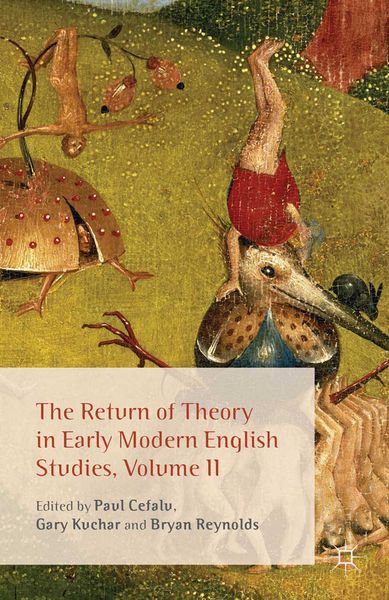
Produktbild: The Return of Theory in Early Modern English Studies, Volume II

The Return of Theory in Early Modern English Studies, Volume II

48,99 €

inkl. gesetzl. MwSt., Versandkostenfrei

Lieferung nach Hause

Beschreibung

Produktdetails

Einband

Taschenbuch

Erscheinungsdatum

01.01.2014

Herausgeber

P. Cefalu + weitere

Verlag

Palgrave Macmillan UK

Seitenzahl

310

Maße (L/B/H)

21,6/14/1,7 cm

Gewicht

376 g

Auflage

2014 edition

Sprache

Englisch

ISBN

978-1-349-46866-9

Beschreibung

Rezension

“Volume II’s outliers make clear the most important point of contention in our return to theory: anti-dualism and what this means for human agency as well as for our understandings of the political and the economic, which also might be to say, of the historical. For this reason, all of us should read … The Return of Theory in Early Modern English Studies, Volume II.” (Sharon O’Dair, Renaissance Quarterly, Vol. 69, 2014)

"For a bracing survey of theoretical developments in the field something one would need if she or he had been absorbed in some particular project for five or ten years without minding the critical discourse of the moment nothing is more economical than the second volume of The Return of Theory in Early Modern English Studies, edited by Paul Cefalu, Gary Kuchar, and Bryan Reynolds, the successor to a similar book edited by Cefalu and Reynolds in 2010. The challenge of such a collection, of course, is that the contributors must produce an essay of literary analysis while discussing the theory it adapts, without reifying the latter too much or lapsing into predictability (because after all, 'theory' in a title like this usually means 'theory with which the reader is already familiar'). I am glad to report that the thirteen chapters here mostly avoid these dangers, led by Julia Reinhard Lupton's luminous essay that brings 'affordance theory, scenography, and architecture and urbanism' into conversation with 'the spaces traveled and tested by Shakespearean drama' (p. 146) and Drew Daniel's turn to Empedocles as an alternative model to the Lucretian Renaissance described in much recent work." Roland Greene, SEL Studies in English Literature 1500-1900

Produktdetails

Einband

Taschenbuch

Erscheinungsdatum

01.01.2014

Herausgeber

Verlag

Palgrave Macmillan UK

Seitenzahl

310

Maße (L/B/H)

21,6/14/1,7 cm

Gewicht

376 g

Auflage

2014 edition

Sprache

Englisch

ISBN

978-1-349-46866-9

Herstelleradresse

Libri GmbH
Europaallee 1
36244 Bad Hersfeld
DE

Email: gpsr@libri.de

Kundinnen und Kunden meinen

0 Bewertungen

Informationen zu Bewertungen

Zur Abgabe einer Bewertung ist eine Anmeldung im Konto notwendig. Die Authentizität der Bewertungen wird von uns nicht überprüft. Wir behalten uns vor, Bewertungstexte, die unseren Richtlinien widersprechen, entsprechend zu kürzen oder zu löschen.

Die Bewertungen sind nach Format, Anzahl Sterne und Datum sortiert.

Verfassen Sie die erste Bewertung zu diesem Artikel

Helfen Sie anderen Kund*innen durch Ihre Meinung

Kundinnen und Kunden meinen

0 Bewertungen filtern

  • Produktbild: The Return of Theory in Early Modern English Studies, Volume II
  • Acknowledgements Notes on the Contributors Introduction PART I: POSTHUMANISM 1. It's (for) you; or, the tele-t/r/opical post-human; Julian Yates 2. Margaret Cavendish and the Creation, Publishing, and Empowering of Subjectivity in the Blazing World; Dan Mills 3. The Bee and the Sovereign (II): Segments, Swarms, and the Early Modern Multitude, Joseph Campana PART II: ECOCRITICISM 4. Early Modern Ecocriticism; Ken Hiltner 5. Horticulture of the Head: The Vegetable Life of Hair in Early Modern English Thought; Edward Geisweidt 6. The Private Lives of Trees and Flowers; Douglas Trevor PART III: HISTORICAL PHENOMENOLOGY 7. Shakespearean Softscapes: Hospitality, Phenomenology, Design; Julia Reinhard Lupton 8. Describing the Sense of Confession in Hamlet; Matthew J. Smith 9. '''Tis insensible, then?': Language and Action in 1 Henry IV'; James A. Knapp 10. ''We Prove Mysterious by This Love': John Donne and the Intimacy of Flesh; Christopher Stokes PART IV: HISTORICISM NOW 11. Milton, Habermas, and the Dynamics of Debate; James Kuzner 12. 'Copious Measures': The Sidney Psalms and the Meaning of Abundance; Kenneth Graham 13. The Empedoclean Renaissance; Drew Daniel Index