Nicht lieferbar

Rian Thum
Gebundenes Buch
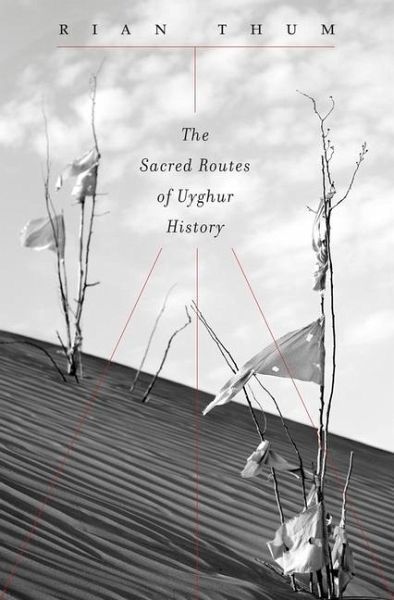
The Sacred Routes of Uyghur History
Versandkostenfrei!
Nicht lieferbar
For 250 years the Turkic Muslims of Altishahr, who now call themselves Uyghurs, have cultivated a sense of history and identity that challenges Beijing's national narrative. The roots of this history run deeper than recent conflicts, Rian Thum says, to a time when manuscripts and pilgrimage along the Silk Road dominated understandings of the past.
Rian Thum is Senior Lecturer in History at the University of Manchester. A contributor to the New York Times, the Washington Post, Foreign Affairs, and The Nation, he is the author of The Sacred Routes of Uyghur History, winner of the Fairbank Prize for East Asian History from the American Historical Association and the Hsu Prize for East Asian Anthropology from the American Anthropological Association.
Produktdetails
- Verlag: De Gruyter
- Seitenzahl: 336
- Erscheinungstermin: 13. Oktober 2014
- Englisch
- Abmessung: 244mm x 161mm x 30mm
- Gewicht: 624g
- ISBN-13: 9780674598553
- ISBN-10: 0674598555
- Artikelnr.: 40753196
Herstellerkennzeichnung
Libri GmbH
Europaallee 1
36244 Bad Hersfeld
gpsr@libri.de
In The Sacred Routes of Uyghur History, [Thum] documents how the Muslims of the region now called Xinjiang understood their past in the three centuries before the Cultural Revolution. Then he explains how that historical identity was torn apart, by inside and outside forces, in the course of the 20th century... What makes Sacred Routes so valuable is its coverage of both the modern and pre-modern periods, taking us back before the Chinese conquest of Altishahr. This enables Thum to show what happened to the older cultural technologies of manuscript, shrine, and pilgrimage in the age of mass printing, competing nationalisms, and commercial tourism... Refusing to reduce his 'biography of history' in Altishahr to a simplistic binary of
Mehr anzeigen
oppression and opposition, Thum instead leads readers beyond the familiar ideologies of modern times toward older ways of knowing and belonging. The empathy and magnitude of this humanist project show the experience of the past in a society few have tried to understand in its own terms... This is Uyghur history as everyman's history.
-- Nile Green Los Angeles Review of Books
A pioneering work. The Sacred Routes of Uyghur History explores the complex relationship between history production, social practice, and space, and traces the transformation of specific historical genres in response to changing political contexts and the increasing role of the state. By examining the development of manuscript culture and technology, it provides a new perspective on the study of the history of the region.
-- Ildikó Bellér-Hann, University of Copenhagen
Thum's brilliant depiction of historical practice in Altishahr-Chinese Central Asia-is nothing less than a new understanding of what history is, how it is practiced, and how it works. The Sacred Routes of Uyghur History shows how the interplay of shrine pilgrimage, tazkirah recitation, tomb graffiti, recombinant manuscripts, and later, printed biographies, reflected and constituted a historical community in Xinjiang that was not dynastic, religious, or national but still comprised a powerful and pervasive identity. This book should be read not only by specialists on China, Central Asia, and the Islamic world, but by all historians, for its insights into alternative but vital modes of historiography on the limes of Eurasian empire and the cusp of colonial modernity.
-- James A. Millward, Georgetown University
-- Nile Green Los Angeles Review of Books
A pioneering work. The Sacred Routes of Uyghur History explores the complex relationship between history production, social practice, and space, and traces the transformation of specific historical genres in response to changing political contexts and the increasing role of the state. By examining the development of manuscript culture and technology, it provides a new perspective on the study of the history of the region.
-- Ildikó Bellér-Hann, University of Copenhagen
Thum's brilliant depiction of historical practice in Altishahr-Chinese Central Asia-is nothing less than a new understanding of what history is, how it is practiced, and how it works. The Sacred Routes of Uyghur History shows how the interplay of shrine pilgrimage, tazkirah recitation, tomb graffiti, recombinant manuscripts, and later, printed biographies, reflected and constituted a historical community in Xinjiang that was not dynastic, religious, or national but still comprised a powerful and pervasive identity. This book should be read not only by specialists on China, Central Asia, and the Islamic world, but by all historians, for its insights into alternative but vital modes of historiography on the limes of Eurasian empire and the cusp of colonial modernity.
-- James A. Millward, Georgetown University

Schließen
In The Sacred Routes of Uyghur History, [Thum] documents how the Muslims of the region now called Xinjiang understood their past in the three centuries before the Cultural Revolution. Then he explains how that historical identity was torn apart, by inside and outside forces, in the course of the 20th century... What makes Sacred Routes so valuable is its coverage of both the modern and pre-modern periods, taking us back before the Chinese conquest of Altishahr. This enables Thum to show what happened to the older cultural technologies of manuscript, shrine, and pilgrimage in the age of mass printing, competing nationalisms, and commercial tourism... Refusing to reduce his 'biography of history' in Altishahr to a simplistic
Mehr anzeigen
binary of oppression and opposition, Thum instead leads readers beyond the familiar ideologies of modern times toward older ways of knowing and belonging. The empathy and magnitude of this humanist project show the experience of the past in a society few have tried to understand in its own terms... This is Uyghur history as everyman's history.
-- Nile Green Los Angeles Review of Books
A pioneering work. The Sacred Routes of Uyghur History explores the complex relationship between history production, social practice, and space, and traces the transformation of specific historical genres in response to changing political contexts and the increasing role of the state. By examining the development of manuscript culture and technology, it provides a new perspective on the study of the history of the region.
-- Ildikó Bellér-Hann, University of Copenhagen
Thum's brilliant depiction of historical practice in Altishahr-Chinese Central Asia-is nothing less than a new understanding of what history is, how it is practiced, and how it works. The Sacred Routes of Uyghur History shows how the interplay of shrine pilgrimage, tazkirah recitation, tomb graffiti, recombinant manuscripts, and later, printed biographies, reflected and constituted a historical community in Xinjiang that was not dynastic, religious, or national but still comprised a powerful and pervasive identity. This book should be read not only by specialists on China, Central Asia, and the Islamic world, but by all historians, for its insights into alternative but vital modes of historiography on the limes of Eurasian empire and the cusp of colonial modernity.
-- James A. Millward, Georgetown University
-- Nile Green Los Angeles Review of Books
A pioneering work. The Sacred Routes of Uyghur History explores the complex relationship between history production, social practice, and space, and traces the transformation of specific historical genres in response to changing political contexts and the increasing role of the state. By examining the development of manuscript culture and technology, it provides a new perspective on the study of the history of the region.
-- Ildikó Bellér-Hann, University of Copenhagen
Thum's brilliant depiction of historical practice in Altishahr-Chinese Central Asia-is nothing less than a new understanding of what history is, how it is practiced, and how it works. The Sacred Routes of Uyghur History shows how the interplay of shrine pilgrimage, tazkirah recitation, tomb graffiti, recombinant manuscripts, and later, printed biographies, reflected and constituted a historical community in Xinjiang that was not dynastic, religious, or national but still comprised a powerful and pervasive identity. This book should be read not only by specialists on China, Central Asia, and the Islamic world, but by all historians, for its insights into alternative but vital modes of historiography on the limes of Eurasian empire and the cusp of colonial modernity.
-- James A. Millward, Georgetown University
Schließen
Für dieses Produkt wurde noch keine Bewertung abgegeben. Wir würden uns sehr freuen, wenn du die erste Bewertung schreibst!
Eine Bewertung schreiben
Andere Kunden interessierten sich für