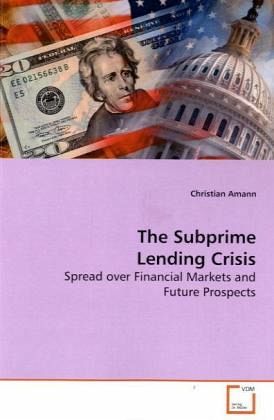
The Subprime Lending Crisis
Spread over Financial Markets and Future Prospects
Versandkostenfrei!
Versandfertig in 6-10 Tagen
32,99 €
inkl. MwSt.

PAYBACK Punkte
16 °P sammeln!

In my book I analyzed what caused the U.S. subprimemortgage market meltdown and why this triggered aglobal credit crunch. In the years before risinghouse prices, favourable market conditions and awell-defined channel of financial intermediariesdrove the expansion of the U.S. subprime mortgagemarket. The result was that borrowers with shakycredit history who did not satisfy standardunderwriting criteria obtained loans, which waspraised as innovation. Subprime mortgage loans werepacked into complex bundles of securities and sold toinvestors all around the world. In 2006, thousands ofhomeowners b...
In my book I analyzed what caused the U.S. subprime
mortgage market meltdown and why this triggered a
global credit crunch. In the years before rising
house prices, favourable market conditions and a
well-defined channel of financial intermediaries
drove the expansion of the U.S. subprime mortgage
market. The result was that borrowers with shaky
credit history who did not satisfy standard
underwriting criteria obtained loans, which was
praised as innovation. Subprime mortgage loans were
packed into complex bundles of securities and sold to
investors all around the world. In 2006, thousands of
homeowners became delinquent and defaulted on their
mortgage payments when the housing bubble was
bursting and interest rate reset to higher levels
because they could only afford the initial teaser
rate of their hybrid adjustable rate mortgages.
Unknown exposure dried up the demand for
mortgage-related securities. Banks had to write down
billions of dollars because of losses of
subprime-related securities and some of them were
bailed out. Fears and uncertainty caused a crisis of
liquidity and confidence, a global credit crunch in
financial markets and a sell of on equity markets.
mortgage market meltdown and why this triggered a
global credit crunch. In the years before rising
house prices, favourable market conditions and a
well-defined channel of financial intermediaries
drove the expansion of the U.S. subprime mortgage
market. The result was that borrowers with shaky
credit history who did not satisfy standard
underwriting criteria obtained loans, which was
praised as innovation. Subprime mortgage loans were
packed into complex bundles of securities and sold to
investors all around the world. In 2006, thousands of
homeowners became delinquent and defaulted on their
mortgage payments when the housing bubble was
bursting and interest rate reset to higher levels
because they could only afford the initial teaser
rate of their hybrid adjustable rate mortgages.
Unknown exposure dried up the demand for
mortgage-related securities. Banks had to write down
billions of dollars because of losses of
subprime-related securities and some of them were
bailed out. Fears and uncertainty caused a crisis of
liquidity and confidence, a global credit crunch in
financial markets and a sell of on equity markets.
Andere Kunden interessierten sich für