
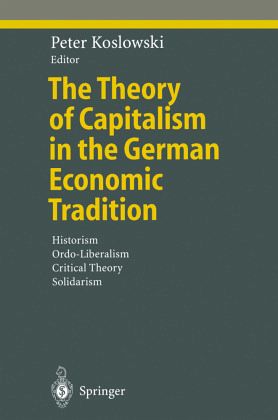
The Theory of Capitalism in the German Economic Tradition
Historism, Ordo-Liberalism, Critical Theory, Solidarism
Herausgegeben: Koslowski, Peter

PAYBACK Punkte
58 °P sammeln!

The German tradition of economics has been occupied with the topic of capitalism. The intellectual debate about the theory, critique, and reform of capitalism has not only been at the center of Marxist thought but also of the economics of the Historical School, of Ordo-Liberalism, the Frankfurt School, and Solidarism. The competition between different models of capitalism in the world is one of the important issues of the contemporary debate in economics and politics. The book provides the reader with theoretical foundations for this debate. It offers an introduction to central economic thinkers of capitalism and of the market economy coming not only from the tradition of liberalism but also from alternative traditions. The book gives a comprehensive view of the achievements, problems, and outlooks of capitalism.
The theory of capitalism and of the economic order is the central topic of the German economic tradition in the 20th century. Capitalism has not only been the topic for Marxist economics and for the Frankfurt School but also for the Historical School and for the postmarxist theory of capitalism in Ordo- and Neo-Liberalism as well as in Solidarism. The question of the foundations of the economic order of the market economy and of capitalism as well as the problem whether a third path between capitalism and social ism is possible occupied this tradition from the Historical School to Ordo Liberalism and the theory of the social market economy. The theory of capitalism and of the social market economy as well as the critique and reform developed in this theoretical tradition is important for the theory of economic systems as well as for today's problems of the eco nomic order. Its relevance for the present world economy is visible in the discussions whether there exist different models of capitalism and whether they can be described as the Anglo-American and as the Rhenish model of capitalism influenced by the thought of the German economic tradition. Michel Albert, the author of this classification, gave the key-word in his book Capitalism against Capitalism. The papers of this book can help to clarify this debate by giving a first hand introduction to some of the main economic thinkers of capitalism.
Andere Kunden interessierten sich für