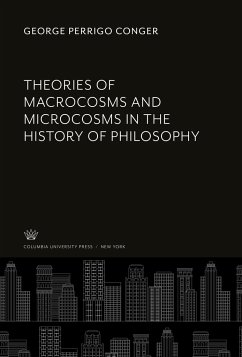


Theories Of Macrocosms And Microcosms In The History Of Philosophy
Versandkostenfrei!
Versandfertig in 1-2 Wochen
19,99 €
inkl. MwSt.
Weitere Ausgaben:

PAYBACK Punkte
10 °P sammeln!

What is the relationship between the universe and the self? Few questions have stirred the philosophical imagination as deeply as this. In Theories Of Macrocosms And Microcosms In The History Of Philosophy, George Perrigo Conger offers a masterful collection of philosophical essays that trace the enduring dialogue between the vast cosmos and the intimate world within each individual. Spanning classical philosophy themes to early 20th century thought, Conger's work stands as a landmark in historical philosophical studies. Through rigorous philosophical history analysis and comparative philosoph...
What is the relationship between the universe and the self? Few questions have stirred the philosophical imagination as deeply as this. In Theories Of Macrocosms And Microcosms In The History Of Philosophy, George Perrigo Conger offers a masterful collection of philosophical essays that trace the enduring dialogue between the vast cosmos and the intimate world within each individual. Spanning classical philosophy themes to early 20th century thought, Conger's work stands as a landmark in historical philosophical studies. Through rigorous philosophical history analysis and comparative philosophy texts, he explores how thinkers across ages have grappled with metaphysical concepts, seeking meaning in the interplay of macrocosm and microcosm. Each essay invites readers to reflect on the universe and self, providing both a rich resource for philosophy students and a deeply engaging journey for academic philosophy readers. The clarity and depth of Conger's analysis make this volume an essential reference for anyone fascinated by the evolution of macrocosm microcosm philosophy. Republished by Alpha Editions in a careful modern edition, this volume preserves the spirit of the original while making it effortless to enjoy today - a heritage title prepared for readers and collectors alike. Conger's work, long admired by scholars, now returns as more than a scholarly reference: it is a cultural treasure, inviting both casual readers and classic-literature collectors to explore the profound connections that shape our understanding of the world and ourselves.
Andere Kunden interessierten sich für